Politics of Silence: Artsakh, Memory and Armenian Democracy
With Armenia’s June 7 parliamentary elections now less than a month away, the race is fully underway. The official campaign period kicked off on May 8 with 19 political forces in the running. Among them, ruling party Civil Contract is now on the trail, with its leader Prime Minister Nikol Pashinyan on campaign leave and taking its message across the country: that this election is about embracing the ideology of “Real Armenia” (namely that Armenians must accept Armenia within its current, not historical, borders), and trusting in a future built on economic and institutional transformation rather than permanent national emergency. In presenting the party’s program, Pashinyan has framed international legitimacy as Armenia’s primary external-security tool and cast the vote as a choice to “stand up for peace.”
On its face, this is a perfectly intelligible political platform, one clearly designed to project stability, pragmatism, and forward movement. But in the months leading up to this campaign, Armenia has also seen a growing pressure to narrow and discipline public speech around Artsakh, to soften or sanitize how Armenian loss may be openly grieved, and to treat memory itself as an inconvenience to be managed. The controversial removal of Armenian Genocide Museum-Institute director Edita Gzoyan, after she reportedly gave U.S. Vice President JD Vance a book on the Nagorno-Karabakh conflict, was one such moment.
Another was Pashinyan’s confrontation on the Yerevan metro with an Artsakh refugee mother traveling with her son after she refused a campaign pin bearing the map of Armenia’s internationally recognized borders, saying they had a “different map” and holding fast to her hope of returning to Artsakh. Pashinyan then publicly berated her, referring to Nagorno-Karabakh Armenians as “runaways” and refuting the accusation that he had “given away” Artsakh, before later apologizing for his outburst.
Things took a much darker turn on May 18 after a video surfaced showing masked, armed men threatening Pashinyan’s life, blaming him for the loss of Nagorno-Karabakh, and urging voters not to support him. That threat is abhorrent and must be condemned outright. But Pashinyan’s own furious response – calling the men “scum” and “scoundrels” and then again invoking that Nagorno-Karabakh Armenians “ran away”— is problematic. Similarly volatile confrontations with members of the public during campaign rallies, including with a disgruntled woman whose brother has been missing since the 2020 war, only adds fuel to an already deepening polarization.
Add to that his refusal to characterize the September 2023 forced displacement of the entire Armenian population of Nagorno-Karabakh as ethnic cleansing, dismissing such language as “harmful,” and his explicit rejection of any agenda of restoring so-called “historical justice,” and a troubling pattern emerges. One might perhaps understand the Prime Minister’s own political reluctance to use the term himself. But to go further and stigmatize others’ use of accurate language as harmful is something else entirely, with an obvious chilling effect on truthful public expression.
Moreover, what exactly Pashinyan means by rejecting “historical justice” is not entirely clear, but it presumably includes, at a minimum, claims tied to the crimes committed against Armenians in the 2020 and 2023 Artsakh wars. Armenia did, in fact, begin pursuing accountability for these through international courts. But under the peace agreement initialed in Washington on August 8, 2025, Armenia and Azerbaijan would be required to terminate their interstate cases before forums such as the International Court of Justice and the European Court of Human Rights within a month of the agreement’s entry into force, and to refrain from initiating any new cases thereafter. This is not an abstract concern. Pashinyan has repeatedly signaled his readiness to drop those cases on a reciprocal basis as part of peace, saying that Armenia should move not only beyond international litigation, but past the disputes themselves.
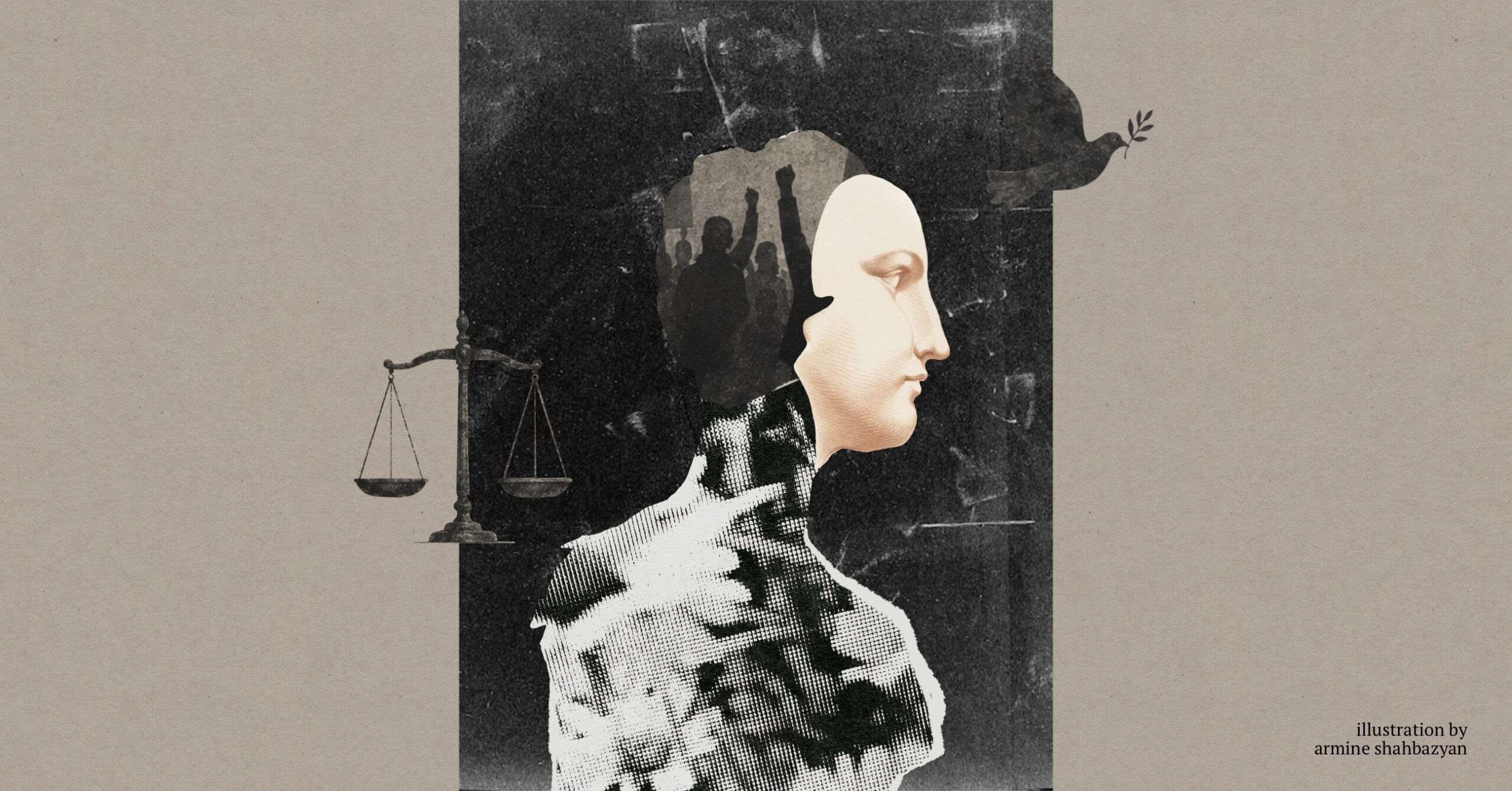
Such a sweeping clause – one that forecloses avenues for justice relating to past, present and future claims alike – is rather unusual in peace agreements, and the prospect of dropping those cases as part of a peace deal risks stripping justice from the process altogether. Those proceedings were never going to heal society on their own, but they did at least preserve a formal avenue for recognition, redress, and the establishment of a record. If those avenues are now being eliminated while public discourse around Artsakh is also being limited at home, then the danger is not only peace without justice, but peace through amnesia. In this scenario, Armenia is not resolving the justice question so much as displacing it.
This is why some form of transitional justice mechanism is becoming increasingly urgent: to help fill the void and ensure that peace is not purchased at the cost of truth and public trust in the freedom to express it. Citizens are being asked not only to choose a government, but also, explicitly or implicitly, to suppress part of their lived reality. The issue before us, then, is no longer just a policy of peace, but also one of silence and the damage it can do to Armenian democracy. That damage lies in the shrinking of civic space around grief, memory and loss; in the pressure to self-censor; and in the erosion of the trust that democratic life depends on. Speak too openly about Artsakh and you are framed as unhelpful, stuck in the past, disruptive to normalization. Insist on justice and you are treated as an obstacle to peace. Over time, people stop feeling that they can participate fully as themselves in matters that directly or indirectly concern them.
This matters all the more because Armenia’s democratic gains since 2018 are real and hard-won. The Velvet Revolution opened political space, expanded freedoms, and helped set Armenia on a more open and pluralistic path – one whose progress, including in recent years and even just two weeks ago on the international stage, should not be taken for granted. And there are undeniably strong arguments for wanting to preserve and build on that progress. But this is not an argument for or against the current leadership or any rival contender. It is an argument that, if preserving and deepening those gains is truly the goal, then protecting the freedom to speak openly – including, if not especially, about grief, trauma and Artsakh – must be part of that democratic promise too.
As previously argued in EVN Report, one possible answer to the justice deficit left by the peace agreement would be a bilateral truth commission. That remains conceptually important, even if ongoing Azerbaijani hostility makes such a mechanism difficult to imagine in the near term. But if yesterday’s assassination threat against Pashinyan over the loss of Nagorno-Karabakh, and his vitriolic response to it, together with his heated exchange with the Artsakh refugee mother, made anything clear, it’s that Armenia also needs something inward-facing: a serious national process – whether commission-based, hybrid, consultative, or otherwise innovative – that acknowledges the full scope of harm suffered by Armenians of Artsakh and by Armenia itself, including displacement, loss of life, destruction of homes, captivity, disappearance, cultural erasure, and the collapse of trust in both international and domestic guarantees, while also creating space for an honest internal reckoning with the increasingly hardened
Transitional justice mechanisms are not alien to Europe or the Americas, but they remain relatively unfamiliar in the post-Soviet space. In the absence of a ready-made regional template, Armenia has an opportunity to show its international legitimacy and democratic character, not to mention the seriousness of its westward pivot, by beginning to build a process of its own: victim-centered, independent, and unapologetically truthful. A state becomes more secure, not less, when citizens trust that their pain counts and that their truth is not punishable. If peace in Armenia is to mean anything lasting, it must also make room for the authentic and full expression of grief, memory and loss. Anything less risks weakening the very democratic resilience Armenia will need in the years ahead.
Sheila Paylan currently serves as a Eurasia Democratic Security Network (EDSN) Fellow at the Democratic Security Institute.