
Strategic Synchronization on the Baku Line: What Does Turkish Foreign Minister Hakan Fidan’s Visit to Azerbaijan Tell Us?
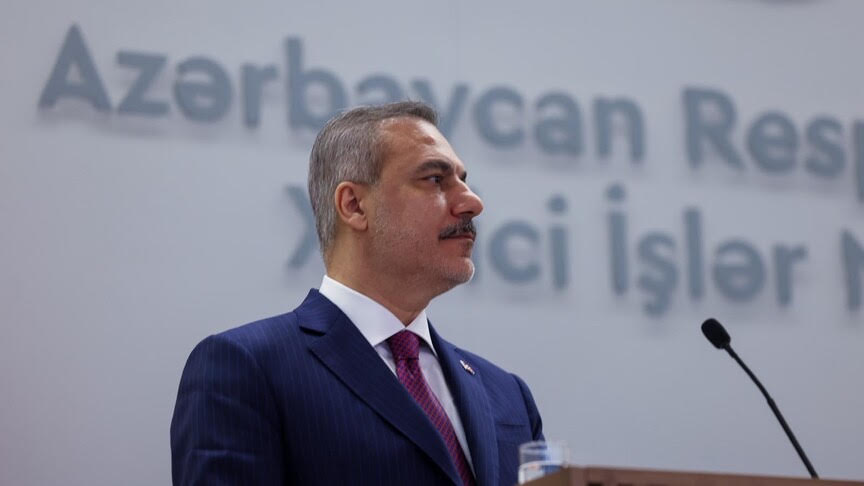
Minister Fidan’s visit to Baku should be read as a strategic contact that combines the brotherhood of the past with the geopolitics of today, and the projects of today with the vision of the Turkic world of tomorrow.
Ömer Faruk Karaman
Anatolia Agency
Dr. Ömer Faruk Karaman, Assistant Professor at the Faculty of Political Science, Çanakkale Onsekiz Mart University, wrote for AA Analysis about Foreign Minister Hakan Fidan’s visit to Baku and the regional and geopolitical reflections of Turkey-Azerbaijan relations in the context of the common future vision of the Turkic world.
Foreign Minister Hakan Fidan’s visit to Azerbaijan on September 15-16, 2026, carries meanings beyond routine diplomatic contacts on the Ankara-Baku line. This visit, while recalling the historical and emotional depth of the “One nation, two states” concept, also reveals the codes of the new regional architecture taking shape around the South Caucasus, the Black Sea, the Strait of Hormuz, the Central Corridor, and the Organization of Turkic States (OTS).
Fidan’s meeting with Azerbaijani Foreign Minister Ceyhun Bayramov in Baku, followed by his reception by President Ilham Aliyev, and the discussion of the defense and security dimension clearly demonstrate the multifaceted and strategic nature of the visit. In relations between Turkey and Azerbaijan, diplomacy is often shaped not only by statecraft but also by the powerful emotions carried by a shared memory. The fact that Minister Fidan’s visit coincided with the 108th anniversary of the liberation of Baku by the Caucasian Islamic Army under the command of Nuri Pasha added symbolic depth to the visit.
September 15, 1918, is a turning point not only in the history of Baku but also in the shared memory of the Turkic world, a date when the price of brotherhood was paid with blood, sacrifice, and solidarity. Minister Fidan’s commemoration of the martyrs on this occasion shows that today’s diplomacy has not severed ties with the memory of the past, but rather carries that memory into the future with a vision of peace, stability, and development. This historical foundation has been further strengthened in recent years through an institutional framework. Turkey was the first state to recognize Azerbaijan’s independence, the High-Level Strategic Cooperation Council was established in 2010, and relations were elevated to the level of alliance with the Shusha Declaration signed on June 15, 2021. Therefore, the relationship between Ankara and Baku today is not merely a good neighborly or classic strategic partnership. This relationship has transformed into an axis that transcends the regional scale in terms of political coordination, defense industry, energy security, transportation lines, trade, public diplomacy, and the institutional future of the Turkic world. From Historical Ties to Strategic Partnership.
One of the most important aspects of the visit is the shared perspective on how to establish the post-war period in the South Caucasus. Throughout the years that Karabakh was under occupation, Turkey openly maintained its support for Azerbaijan’s territorial integrity. Today, the priority is to transform the gained military and political ground into lasting peace, economic connectivity, and regional prosperity. Minister Fidan’s message, “We wish for the South Caucasus to be known not for conflicts, but for peace, transportation, energy, trade, and economic development,” summarizes Ankara’s perspective on the new era. This perspective is not limited solely to the Azerbaijan-Armenia peace process. Projects such as the Zangezur Corridor, the Nakhchivan connection, the Baku-Tbilisi-Kars Railway, and the Kars-Iğdır-Aralık-Dilucu Railway stand out as key initiatives that will strengthen the physical integration of the Turkic world.
According to Bayramov’s statement, approximately 95% of the road construction and approximately 75% of the railway construction along Azerbaijan’s border with Armenia have been completed, with both projects planned for completion in the first half of 2027. Minister Fidan also stated that with the completion of the Kars-Dilucu railway by the end of 2029, a train from Azerbaijan will be able to reach Türkiye without interruption. When these lines are completed, the issue will cease to be merely a railway or road project; it will create a geo-economic backbone that enables stronger access for the Turkic world to Anatolia and Europe, and for Türkiye to Central Asia via the Caspian Sea.
Another important aspect of the visit, in light of regional developments, concerns the Black Sea and the Strait of Hormuz. The ongoing Russia-Ukraine war, lasting over 4.5 years, with its attacks on civilian vessels in the Black Sea and its impact on energy and food security, makes consultations between Ankara and Baku even more critical. Minister Fidan’s emphasis on the rigorous implementation of the Montreux Convention, the Black Sea Grain Initiative, and the unacceptable spread of the war to the Black Sea reflects Türkiye’s capacity to contain crises and find diplomatic middle ground. The message regarding the need to return to safe, uninterrupted, and free passage through the Strait of Hormuz shows that the Turkey-Azerbaijan consultations are not limited to the Caucasus but are also linked to global energy and maritime trade security.
On the economic front, the visit includes concrete goals and new opportunities. The target of $7.08 billion in trade volume between Turkey and Azerbaijan by 2025, and the leaders’ setting of a $15 billion target, highlight the potential for deepening economic relations. The fact that approximately 5,800 Turkish companies operate in Azerbaijan, making Türkiye the country with the most foreign-capital companies in Azerbaijan, and the high level of mutual investments, shows that the relations between the two countries are based on a solid economic foundation. A green energy dimension is also added to this. Bayramov’s speech, in which he referred to projects such as transporting green energy produced in Azerbaijan to Europe via the Black Sea, a new energy cable on the Azerbaijan-Georgia-Turkey-
At the heart of all these topics lies the institutional future of the Turkic world. Minister Fidan’s reminder that the TDT Foreign Ministers Council Meeting will be held in Ankara on October 29th, and the 13th TDT Summit on October 30th, and his characterization of the summit as a historic step that will strengthen the common future vision of the Turkic world, makes the Baku visit part of the preparation process for the Ankara summit. Bayramov’s description of the TDT as a family structure bringing together brotherly countries reveals that the organization is seen not only as a diplomatic platform, but also as a ground for shared belonging and strategic coordination.
At this point, the Turkey-Azerbaijan partnership functions as a “core axis” for the Turkic world. As the harmony between Ankara and Baku strengthens, the TDT’s capacity to produce more concrete projects in the fields of transportation, energy, defense, digitalization, trade, and public diplomacy also increases. The future of the Turkic world depends not only on a shared historical and cultural narrative, but also on supporting this narrative with a shared infrastructure, a shared market, a shared technology, and a shared security vision.
In this respect, Minister Fidan’s visit to Baku should be read as a strategic contact that combines the fraternal feelings of the past with the geopolitics of the present, and the projects of the present with the vision of the Turkic world of the future. In the coming period, the Ankara-Baku line can be expected to be decisive in three areas. Firstly, the consolidation of the Azerbaijan-Armenia peace process could move the South Caucasus away from the memory of conflict and towards a new economic order centered on connectivity. Secondly, the completion of the Middle Corridor and the Zangezur line could make the Turkic world more visible and indispensable in European-Asian trade. Thirdly, the Ankara Summit of the Turkic World Trade Organization could offer the opportunity to transform solidarity among Turkic states into more institutional and implementable projects.
In conclusion, Minister Fidan’s visit to Azerbaijan is not merely a new link in the diplomatic traffic between two allied countries. This visit reflects a broad strategic picture, ranging from the historical memory of Baku’s liberation to the spirit of alliance in the Shusha Declaration, from the post-Karabakh peace process to the geo-economic potential of the Central Corridor, from the Black Sea and Hormuz crises to the shared future vision of the Turkic World Order that will take shape in Ankara. The brotherhood between Turkey and Azerbaijan is not only a solidarity between two states today, but also a will to transform the idea of Turkic world unity into a force that generates regional peace, economic development, and global influence. To the extent that this will is supported by sustainable projects, the Turkic world will become one of the rising geopolitical realities of the 21st century.
Reporter: Afra Betul Aydar