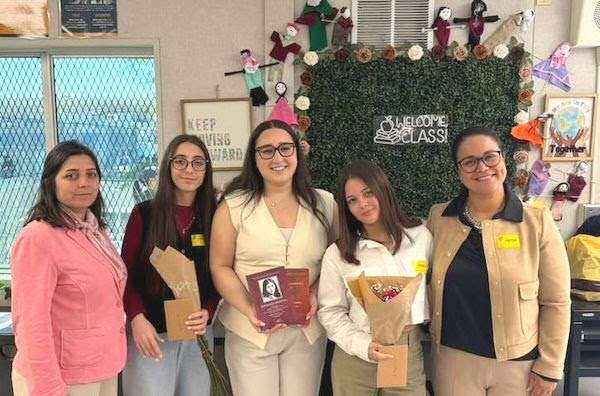
| Ruzanna Nikoghosyan discussed her discovery of her family’s story of survival during the Armenian Genocide. She said she had long been troubled by her grandfather’s inexplicable refrain, “Ani, so close, but so far away.” One day, standing on the banks of the Arax River and admiring the ancient city of Ani through barbed wire and with Turkish military watchtowers separating her from the city, she understood her grandfather’s meaning. She returned to her village and learned her family’s history, albeit with some mysteries still to be uncovered.
Luciana Van Horenbeck, whose essay addressed Armenian Genocide resistance through art, told U.S. students how she found refuge, comfort, and strength in the poems of Silva Kaputikyan, Vahan Tekeyan, and Moughegh Ishkhan. She said she believes the poems and the continued use of the Armenian language are forms of resistance and cultural preservation.
Christina Chiranian, GenEd’s Educational Programming Assistant who teaches history at Sylmar Charter High School, organized the trip’s educational itinerary. She said her students were extremely enthusiastic about meeting Ruzanna and Luciana. “Yesterday’s guest speakers were amazing!” wrote one student, “I loved hearing about how language can be a form of resistance! It was cool to see how students do the same things we do in different countries… especially hearing it in Spanish from the visitors from Uruguay. It was an experience I’ll never forget.”
The teacher-escorts learned about educational methods in the U.S. “I thought that non-Armenians wouldn’t care about the Armenian Genocide,” said Papyan, “But here are ‘odar’ students not only learning, but excited and wanting to learn about Armenians.”
The essay contest was initiated in 2024 by Uruguay’s National Administration of Public Education in cooperation with the Armenian General Benevolent Union (AGBU). Participants must conduct research and submit an argumentative essay supported by evidence under the mentorship of a teacher. Finalists give an oral defense of their essays before the winners are chosen.
Contest leader Javier Polatian expressed his satisfaction with the contest’s trip results, saying, “GenEd is behind the real success of this trip. There was a perfect balance between higher education, public schools, Armenian schools, cultural organizations, and political organizations. It was all so perfect.”
Edita Gzoyan, who co-led the contest program on behalf of the Armenian Genocide Museum-Institute, expressed satisfaction with the growing partnership between organizations in Uruguay, Armenia, and the U.S. “We all believe deeply in the power of genocide education to connect young people, strengthen historical understanding, and promote responsibility toward the prevention of future atrocities,” said Gzoyan. |