
‘The caves came first’ — how an Armenian artist breathed new life into Goris
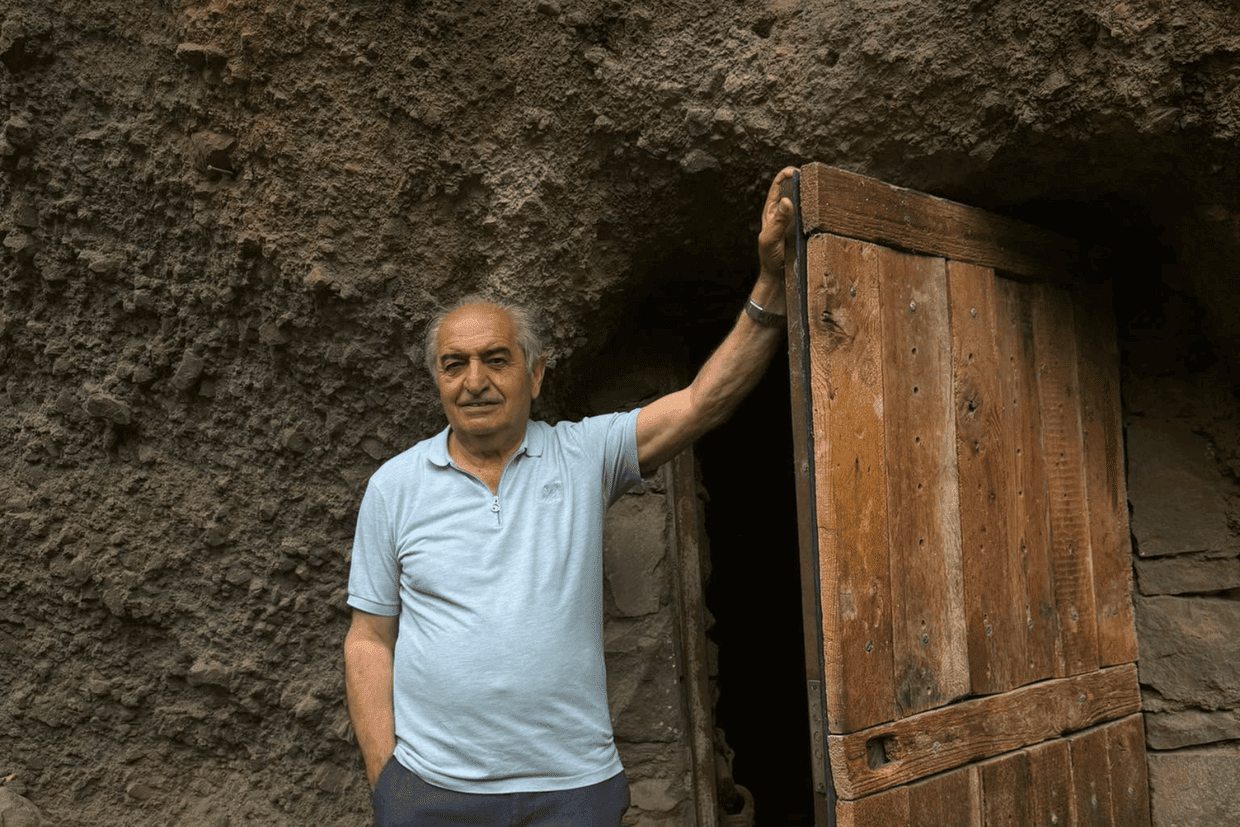
Armenian painter Zhirayr Martirosyan has built his art studio in one of more than 10,000 abandoned caves scattered around Goris and its surroundings.
Zhirayr Martirosyan standing in front of the entrance to his cave studio. Photo courtesy of Mery Chobanyan.
The cave is almost completely dark when you step inside. Paintings disappear into the shadows, the stone walls are hardly visible, and instinctively one wants to reach for their phone’s flashlight. But painter Zhirayr Martirosyan asks his audience to wait. As the darkness slowly begins to dissolve, a shelf emerges, then a canvas leaning against the rock. Sunlight still pours through the open doorway, but something else has changed: the eyes have adjusted.
Martirosyan’s art studio occupies just one of more than 10,000 caves scattered across Goris and its surrounding gorges. A century ago, thousands of people inhabited these caves — Martirosyan’s own father was born in one.

An ‘ingenious’ form of architecture
According to Vardan Sargsyan, the director of the Aksel Bakunts House-Museum in Goris — commemorating the Goris-born writer who was executed in 1937 by the Soviet authorities — anyone born in the area before the 1960s would have been born in a home located within the gorges.
‘The original dwelling was always the cave itself’, Sargsyan tells OC Media, adding that, ‘Later, families expanded the entrance by adding stone or wooden structures in front of it, gradually enlarging the house. The cave came first, and the built additions followed’.

Over time, more stone and wooden rooms were added, particularly by the beginning of the 20th century. As construction techniques became more modern, each generation extended the house a little further outward. People in the village Karahunj still live in houses like this. When entering what looks like a modern home, one is first met by older stone rooms, and at the very back is the original cave.
‘It’s an ingenious form of architecture’, Sargsyan says.

One of the most remarkable examples of this community was the cave theatre. Resembling a miniature version of a contemporary theatre, it is believed that there were special structures for placing the chairs inside the cave. Near the entrance stood a two-story stage with remarkable acoustics, thanks to the unique design of the structure and the type of rock in which it was carved. It remained in use until the 20th century. Even today, when locals celebrate Bakunts, events often begin at the cave theatre.

‘There was a real life in the cave’, Martirosyan says.
Beginning around 1870, the modern town of Goris began to be built on the plain directly across from the old cave settlement. People from different parts of Syunik gradually moved there because it was safer and more convenient. There, they built new houses, which is how the modern town of Goris emerged.
Meanwhile, the old cave village slowly emptied. Starting in 1930, the Soviet authorities began providing housing to families in order to encourage their movement away from the caves. By the 1960s, the last inhabitants had moved out, including Martirosyan’s father, who was only five-years-old when the family left for Baku. Locals, many of whom were left without a job after moving, then began using the abandoned caves to keep livestock or as a garbage dump.

Smaller cave villages also existed throughout the Khndzoresk Gorge, including Ghoghanjugh, Maghanjugh, Kyoru (or Goru), and Ughunishen. In the early 1960s, residents of these villages moved out onto the plateau and established a single new village together.
Building a new future from the abandoned caves
Martirosyan recalls that the last true cave-dweller died a couple of years ago
‘He had such unique tools in his house in Khndzoresk, things I’d never seen before’, Martirosyan tells OC Media. ‘Because I collect various vintage tools for my cave art studio, many people have given me tools, but what I saw there was something extraordinary’.

‘Eventually, I thought it would be better if I had a cave where I could both paint and leave my work’, he says. ‘That was the original idea, but over time it grew into something much bigger. I realized it could become a very interesting space’.

Even so, the process to restore the cave has been extremely expensive. The rock needs reinforcement because stones constantly fall from above, creating safety risks. A cliff that has stood for millions of years gradually erodes; as the supporting soil disappears, the rock eventually collapses under its own weight.
‘I remember one collapse about 20 years ago. Our house isn’t far from here. Suddenly, there was a huge cloud of dust — a massive section of rock had fallen, damaging several caves’, Martirosyan recalls.
‘Beyond restoration, there is also the issue of safety. Before anything else, the entire area needs to be properly stabilized’.

Standing among the enormous rocks of Old Goris, smartphone in hand, it is difficult to imagine that less than a century ago, mothers carried their newborn children with ropes up to the highest caves, men traveled to Iran to perform before the Shah, and children created games out of the natural world around them.