The forgotten Armenian past of Crimea, Ukraine
Since 2014, Russia has promoted a nationalist and irredentist narrative portraying Crimea as “historically Russian land,” using it to justify its illegal occupation and subsequent annexation of the peninsula. While Western governments firmly condemned the move, some observers described Putin’s operation as unlawful but nonetheless legitimate, considering it a correction of a perceived “historical error.” Unfortunately, Russian rhetoric has found several supporters outside the country, a phenomenon facilitated by the generally poor knowledge of Crimean history in the West.
In reality, describing Crimea as a territory that has always belonged to Moscow is a gross oversimplification, if not an outright historical distortion. Over the centuries, the peninsula has experienced multiple forms of political domination and has been inhabited by a wide variety of ethnic groups, including Greeks, Goths, Tatars, Jews, Italians, Russians, Ukrainians, Bulgarians, Germans and Armenians.
The Armenian presence, in particular, was so significant during the late Middle Ages that the peninsula came to be known as “Maritime Armenia.”
The first Armenians arrived during the Early Middle Ages, when Crimean territory was still controlled by the Byzantine Empire. Constantinople employed warriors of Armenian origin, some of whom were stationed in Crimea. However, Armenians became a sizable community only during the 11th century, when thousands fled Anatolia — frequently ravaged by Seljuk incursions — to seek a new life elsewhere. Crimea was likely chosen due to a combination of factors, including its favorable climate, fertile soil and its thriving commercial centers.
Throughout the Middle Ages, Crimean Armenians lived under various political entities, such as the Eastern Roman Empire, the Mongol Empire, the Genoese Republic and the Principality of Theodoro. Genoa played a crucial role in consolidating this settlement, actively encouraging migration from historical Armenia to Crimea. The maritime republic benefited from the presence of Armenians, who served as merchants and soldiers.
During the Late Middle Ages — considered the golden age of Crimean Armenians — their total number may have reached between 150,000 and 200,000.
As a result, the Armenian population sharply declined and, by the 17th century, only a few hundred families remained in Crimea. While the southernmost part of the peninsula was directly ruled by Constantinople, the rest fell under the authority of the Crimean Khanate — founded in 1441 — which functioned as a vassal state of the Ottoman Empire.
Over time, relative stability returned, allowing gradual Armenian migration back to Crimea. Despite Muslim rule, Christian families were able to preserve their ancestral faith in exchange for payment of a special tax known as jizya. Armenian continued to be spoken in several towns, although many adopted Tatar as a first or second language, often writing it in Armenian script.
During the 18th century, the fate of Crimean Armenians was reshaped once again by an external power — this time, a Christian one: the Russian Empire. Following the Russo-Turkish War of 1768–1774, Saint Petersburg and Constantinople signed the Treaty of Küçük Kaynarca, which compelled the Ottomans to relinquish their Crimean possessions to the Crimean Khanate, thereby ending its vassal status. Although the peninsula became de jure independent for the first time in centuries, it de facto passed from Ottoman to Russian suzerainty.
At that time, Crimea was inhabited primarily by four major ethnic groups: Muslim Tatars; Turkic-speaking Jews (Krymchaks and Karaites); Greek Orthodox Christians (Turkophone Urums and Hellenophone Rumei); and Armenians. In 1778, however, Empress Catherine the Great ordered the forced relocation of the peninsula’s Christian population, which was resettled by Russian authorities in newly founded settlements in the Pryazovia region.
This measure aimed both to colonize the sparsely populated shores of the Sea of Azov — annexed by Russia only decades earlier — and to deprive the Crimean Khanate of an important source of revenue. Christians had contributed significantly to the state budget through the payment of jizya; their removal, thus, weakened the Khanate and prepared the ground for its eventual annexation. General Alexander Suvorov oversaw the forced migration of approximately 20,000 Armenians from Crimea to Nakhichevan-on-Don, a newly established city that today forms part of Rostov-on-Don. Greek Orthodox subjects, by contrast, were resettled in what is now Donetsk Oblast, where they founded Mariupol and several smaller settlements.
These events led to the disappearance of Crimea’s historical Christian communities. Nevertheless, following the Russian annexation of the peninsula in 1783, new migration waves, once again, altered the region’s ethnic composition. Saint Petersburg encouraged settlers from across Europe, the Caucasus and Asia Minor to relocate to Crimea to increase the Christian population in a region still largely inhabited by Muslim Tatars. Consequently, between the late 18th and early 20th centuries, thousands of Armenians migrated from Anatolia and the Caucasus to the Taurida Governorate. On the eve of the First World War, the Armenian community in Crimea numbered around 15,000 people.
This presence was interrupted for a second time under the Stalinist regime. During the Second World War, Soviet authorities accused several ethnic groups of collaboration with the enemy and deported them en masse to Central Asia or Siberia. In Crimea, Tatars, Germans, Bulgarians, Italians, Greeks and Armenians were forcibly removed from their homeland and subjected to extremely harsh living conditions. Armenians were deported to Kazakhstan or other regions of Russia, such as Tatarstan, Bashkortostan, Perm Oblast, Omsk Oblast, Sverdlovsk Oblast and Kemerovo Oblast. The demographic vacuum left by the deportees was subsequently filled by Russian, Ukrainian and Belarusian settlers.
These deportations can be regarded as a clear case of ethnic cleansing.
Their purpose was to secure a strategically vital region by removing ethnic groups deemed potentially hostile or “unreliable” and replacing them with populations considered more politically loyal. As a result, Crimea was transformed — for the first time in its history — into a region with an absolute ethnic Russian majority, a demographic shift that would profoundly shape its later political and social trajectory. The victims of these deportations were only allowed to return in the late 1980s, when Mikhail Gorbachev’s reforms eased political repression and lifted the ban on repatriation.
In 1989, returnees founded the Crimean Armenian Society, which periodically publishes its own journal. According to Ukraine’s 2001 census, approximately 10,000 Armenians lived in Crimea; by 2014, that number had risen to 11,030, representing about 0.5% of the peninsula’s population. However, some estimates, such as those in the Armenia Diaspora Encyclopedia, place the figure as high as 20,000.
Today, Russian is the primary language spoken within the Armenian community, and many younger Armenians possess only limited knowledge of their ancestral language. According to the 2014 Russian census, 45% of Crimean Armenians reported knowledge of Armenian, while 99% stated they could speak Russian. The predominantly Slavic character of Crimean society, combined with the high incidence of mixed marriages, poses a significant challenge to the intergenerational transmission of Armenian. Nevertheless, local television and radio broadcast a small number of programs for the minority, and Armenian is taught in select schools.
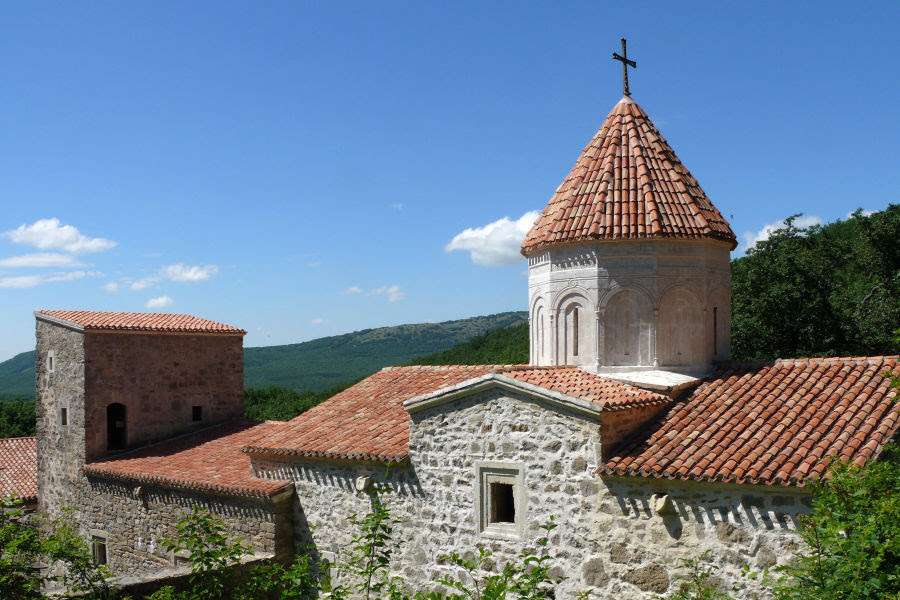
The principal institution dedicated to preserving Armenian culture in Crimea remains the Armenian Apostolic Church. The presence of churches and monasteries built over the centuries bears witness to the deep historical roots of this community. Among the most significant monuments are the Surb Khach Monastery in Staryi Krym and the Surb Sarkis Church in Feodosia, both dating to the Late Middle Ages.
|
Despite its small size today, the Armenian community of Crimea represents a living testament to the peninsula’s complex and multilayered past.
Its history, marked by conquest, colonization, displacement and return, highlights how the region cannot be ascribed to a single nation or ethnicity. Crimea is a beautiful mosaic of peoples and cultures and should be preserved as such, free from the grip of chauvinism.