Tlön, Uqbar, Gandzasar: Notes on the Imaginary Land Called “Caucasian Albania”
“The methodical fabrication of hrönir (says the Eleventh Volume) has performed prodigious services for archaeologists. It has made possible the interrogation and even the modification of the past, which is now no less plastic and docile than the future.”
Jorge Luis Borges,
“Tlön, Uqbar, Orbis Tertius”
in “Labyrinths: Selected Stories and Other Writings”
Jorge Luis Borges invented stories and places so vivid and uncanny that they briefly unsettle the reader’s sense of where reality ends and simulacrum begins. In a single paragraph short essay, “On Exactitude in Science,” the Argentine master storyteller recounts how a make-believe empire’s ingenious cartographers draw a map so exact (a 1:1 correlation) that it grows to the size of the actual empire itself. In another brilliant essay “Tlön, Uqbar, Orbis Tertius,” written in 1940 and with postface addenda in 1941, 1944 and 1947, a secret society of scholars called Orbis Tertius and based in the imaginary land of Uqbar (ironically placed by Borges’ narrator in Asia Minor and near “Armenia”) invents a world, Tlön, down to its languages, which lack nouns. By the story’s end in 1947, Tlön’s artifacts are surfacing in our own world, as reality begins to yield to the fiction.[1]
I have loved Borges’s stories for their ability to make me pause over this troubled world and ponder the relationship between the “real” and the simulacra, the hallucination of the world and the real world, blatantly fabricated fiction and real history. I recalled Borges this week as I watched Hikmet Hajiyev, foreign-policy aide to Azerbaijan’s autocrat and the second most distinguished genocidaire of our time, Ilham Aliyev. Hajiyev, seen with his ear-to-ear grin in a recently posted online clip, led a delegation of European Union and other diplomats through the Armenian monasteries of Gandzasar and Dadivank in Nagorno-Karabakh (Artsakh inArmenian) and Kelbajar.
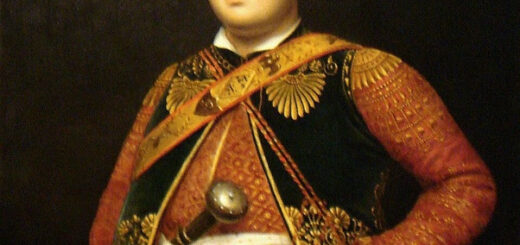
Hasan-Jalal Dawla, an Armenian prince of the real medieval kingdom of Khachen (Խաչէն), whose name was clearly Arabic and Islamicate as was common among Armenians at the time, built the thirteenth-century church of Saint John the Baptist (Surb Hovhaness Mkrtich) inside the monastic complex at Gandzasar (literally Treasure Mountain). He “signed” his pious donation with a carving of himself sitting, Seljuk-style, cross-legged and holding a miniature of the church in his raised hands,accompanied with multiple inscriptions in Classical Armenian.[2]
During that tour, Hajiyev presented this magnificent monastery as the heritage of “Caucasian Albania,” referring to an enigmatic Christian South Caucasian kingdom that disappeared from history during the ninth and tenth centuries. Without citing proper empirical evidence, Hajiyev and Azerbaijani officials and their historians have claimed that the Armenians and their Church hierarchy were complicit with the ninth-century Arab rulers of the region in supposedly bringing the Caucasian Albanian kingdom to a swift end, of systematically erasing original literary work in the now lost language and alphabet of Caucasian Albania.[3]
Some have even accused Armenian restorers and guardians of this endangered heritage of purposefully replacing original Albanian inscriptions with Armenian language replicas of khachkars (Armenian stone-crosses) with ancient-looking inscriptions—all supposedly during the nineteenth and late twentieth centuries. It is interesting to note that even the paleo-Christian, Armenian art form of ornately decorated stone-crosses, known to the world as khachkars, are culturally appropriated by Baku’s historians and transmuted into khachdashes in Azerbaijani Turkish (which unlike the imaginary language of Tlön apparently has nouns that refer to chimeras).[4] The irony is that the Armenian stone-cross inscriptions, meant to anchor memory on enduring material surfaces in order for future generations to remember the dead, are subverted by the Orbis Tertius group to erase that very memory.
Aliyev the son and his aides accomplished what Aliyev père could not in the 1990s. In September 2023, following a nine-month siege and starvation campaign, Baku ethnically cleansed Karabakh’s remaining Armenian population, some 100,000 people, a people indigenous to the land. The operation followed the 2020 war, during which there was credible open-source evidence suggesting that Azerbaijani forces used white-phosphorus or similar incendiary munitions to set fire to forested areas in Armenian-controlled territory. There is also ample evidence that Israeli hi-tech firms had supplied most of the drones and missiles including on-the-ground advisors that enabled Azerbaijani forces, backed militarily by NATO-member Turkey, to triumph in that war.
The physical erasure of Armenian heritage in Karabakh, however, did not begin with the September 2023 exodus. Following the 2020 ceasefire, visual evidence emerged of the desecration of Armenian churches, crosses and monuments in territories that had come under Azerbaijani control. This followed a much longer record of the destruction of Armenian cultural heritage in Nakhijevan, where thousands of Armenian monuments and sites were systematically erased. The destruction in Karabakh accelerated after the removal of its Armenian population, with churches, cemeteries, khachkars, monuments and inscriptions subsequently demolished, desecrated or otherwise erased.[5]
Lost in many accounts of this brutal conflict and ethnic cleansing is the vital role played in the incitement of genocide and the destruction of cultural heritage by Baku’s own version of Orbis Tertius. The members of this group have labored over the last 60 years to create an alternative reality in which the ethic cleansing/genocide of Karabakh’s Armenians is almost a foregone conclusion, if not a necessity.
This group was conceived in the wake of plagiarism-accused historian Ziya Buniyatov’s 1965 monograph “Azerbaijan from the VII-IX Centuries”, a largely fictionalized pseudo-historical account that recast Caucasian Albania as Azerbaijan.[6] This work of dubious scholarship has taught several generations of Azerbaijanis, made uncomfortable by the region’s older and more deeply rooted South Caucasian histories (Armenian and Georgian) that, as an indigenous people themselves, they are, through the Tlön-like invention of a Caucasian Albanian past, the true owners of Karabakh’s monuments and history.[7]
The Armenians, according to this viewpoint, came to Karabakh only as nineteenth-century migrants, settlers and usurpers, following the annexation of the area by the Russian Empire in 1828. What is more, Buniyatov maintained that age-old Armenian inscriptions and manuscripts were in fact not Armenian at all but “Albanian,” and that the Albanians were the ancestors of the Azerbaijani Turks. In so doing, Buniyatov was short-circuiting the historical fact that the Turks entered the region only from the eleventh century onward.
Lest the reader become confused, it is important to state here that Caucasian Albania, was indeed a real place. It was known in Armenian sources as “Ałuankʿ”, in contemporary Arabic accounts as “al-Rāni”, and to the Greeks and Romans as Ἀλβανία/Albania[8] and “Albanoi”.
The Albania of Baku, however, is pure Tlön.
The resemblance between the “Albanization” of Karabakh and Borges’ celebrated short story ends in two places. First, the tale is told not by a writer’s genius but by largely dim-witted functionaries and falsifiers of history such as Buniyatov, his loyal disciple, Farida Mamedova, who surpassed her master, and, most recently Hikmet Hajiyev. Second and more important, where Borges’ Tlön conquered reality only on the page, Baku’s Caucasian Albania arrived by bulldozer, clearing the way for the erasure of a real people and their civilization.
The Borgesian modus operandi of treating the local Armenian population not as the true heirs of the region’s historical monuments as they themselves regard, but as imaginary usurpers of Caucasian Albanian art and architecture is visible in many places. Such deeply flawed and intentionally fabricated accounts of the past have led to calls for the removal of all traces of Armenian “falsifications,” in effect paving the way for the kind of bulldozing that destroyed thousands of stone-crosses at Old Julfa by the defacing, “gouging, sandblasting, or removing of Armenian inscribed stones.”[9] In February 2022, the Azerbaijani Ministry of Culture declared the creation of a special committee to “remove the fictitious traces written by Armenians on Albanian religious temples.”[10]
This lachrymose prognosis for the future of Armenian heritage in its own place of birth has led one connoisseur and historian of art to speculate on what might happen to the Caucasian Albanians of lore and to the Armenians and their heritage:
Finally, there will be a celebration of the “multiculturalism” of Azerbaijan. “Come to Karabakh, home of ancient Christians,” people will say. “Please ignore the gouged-out letters on that stone wall, for it is not an Armenian inscription. There were never Armenians here!” Except for soldiers and invaders, like the ones depicted in a reprehensible museum in Baku, featuring waxen figures of dead Armenian soldiers—a sight so dehumanizing that an international human rights organization, including Azerbaijani activists, cried out for its closure.[11]
Borges’ narrator foresaw a world that would become Tlön. We may now wait in horror as Baku’s historians draw their own maps of Caucasian Albania, perhaps even at one-to-one correlation! For the last 15 or more years, the intrepid researchers at Orbis Tertius have been openly and quite literally redrawing the cartography of the South Caucasus. On their new map, the Republic of Armenia is now labelled “Western Azerbaijan” with the same inscrutable logic as Tlön.
As early as 2007, one of the lesser lights of the Orbis Tertius group, Kamala Imranly, framed the mental map of Armenia in a way only someone with the irony of the Argentine writer could have conceived. In her curious account of Armenian history, “War Against Azerbaijan: Targeting Cultural Heritage”, published in a series tellingly labeled as the “True Facts about Garabagh” [sic] by the Heydar Aliyev Foundation in 2007, Imranly writes:
Although the Republic of Armenia does not have an ethnic Azerbaijani population now, its territory was a native land of Azerbaijanis long before Armenians appeared there for the first time. A considerable portion of the territory of modern Armenia until the occupation by Russia in the early 19th century was part of different states established by the ancestors of Azerbaijanis, namely Caucasian Albania, and after the arrival of Arabs, different Azerbaijani Muslim states such as the Sajids, Salarids, Shaddadids, then Atabays, Hulakids (Elkhanids), Garagoyunlu and Aghgoyunlu, with its peak during the Azerbaijani Safavid state from 1501 to 1736 (excluding for a short period of time being a part of Turkey), the state of Nadir Shah also for about a decade, and finally the Iravan and Nakhchyvan khanates.[12]
Given the tendency of the hallucinatory histories and forged maps like those of fictional Uqbar to materialize in the real world, all people of good will, including citizens of Azerbaijan and Armenia, should remain vigilant and gravely concerned, as should the international community, insofar as it can resist the temptations of the so-called “Azerbaijani laundromat.”[13]
*The author wishes to credit Marc A. Mamigonian for first bringing the Borges story to his attention. Mamigonian’s brilliant short account uses Tlön not in connection with Caucasian Albania but with the Turkish Historical Society’s campaigns of deforming and disfiguring the history of the Armenian genocide of 1915.
Footnotes: