“Whoever Has a ‘Friend’ Like This Needs No Enemy”
By Armine Koundakjian
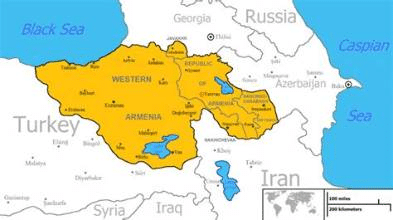
This year marks the 105th anniversaries of the Treaties of Moscow and Kars, under which the First Republic of Armenia was nullified, while most of its territory was handed over to Turkey and so-called Azerbaijan. Through these treaties, Russia saved Turkey by giving it Kars, Surmalu, and Mount Ararat. Nakhichevan and Artsakh were also handed over to Baku. In the name of internationalism, the Armenians paid the highest price of all—their lands. This is what the Pravda newspaper wrote at the time.
Under the treaties of 1921, Russia and Turkey resolved matters essential to their own survival. It is no coincidence that the Treaty of Kars was called the Treaty of Friendship. One hundred and five years later, Turkey and Russia once again found themselves facing the same problem. The war waged against Armenia in Artsakh in September 2020 and the postwar settlement are directly connected to this. A new treaty, Kars-2, is being imposed on Armenia, one intended to legitimize a Russian-Turkish deal at the expense of Armenia’s territorial integrity and loss of sovereignty.
It is already evident that the Russian peacekeepers were anything but peacekeepers; at a convenient moment, they handed Artsakh over. Rather than preserving the land in Artsakh, they oversaw its depopulation of Armenians. Syunik, meanwhile, could find itself in the same situation as Alexandropol (Gyumri) in 1920–1922, when the Turkish army, armed by the Bolsheviks, captured both Kars and Gyumri. Soviet troops then arrived and supposedly saved Armenia from the Turks. Now, Meghri or Kapan could also find themselves in Gyumri’s situation.
But the world is different now. There are the United States and Europe, India and Iran. And Syunik can always give rise to another Nzhdeh…
In addition, these days we are confronted with the idea of the Russian-Turkish 3+3 platform, which is precisely a framework for fragmenting Armenia through extraterritorial corridors, dividing it into pieces, and depriving it of sovereignty. This concerns not only the province of Syunik but the entire territory of Armenia.
It must be understood that the first three countries in the 3+3 format are Turkey, Azerbaijan, and Russia—not Iran.
Unfortunately, our so-called national political thinking is incapable of recognizing today’s challenges and problems, or finding solutions to them. Over the past year, efforts have been made to buy time.
But we will also find out whether they have agreed, as the Bolshevik leaders did in 1921, to the elimination of Armenia at the hands of the Moscow and Ankara administrations.
As Abraham Gasparyan firmly believes and often states, the invincible Armenian DNA has not yet died and will manifest itself at the right moment.