Why Has Pashinyan Become The Darling of Azerbaijan and Turkey? — By Harut Sassounian
With each passing day, Turkey and Azerbaijan are tightening the noose around Armenia’s neck with the blessing of Pres. Donald Trump. His self-proclaimed TRIPP (Trump Route for International Peace and Prosperity) is the best indication of that. Trump cares neither for Armenia nor its interests. He only cares for his own selfish gains, desperately seeking an undeserved Nobel Peace Prize. TRIPP is another name for the Turan Road, linking Turkey and Azerbaijan to the Central Asian Turkic republics — a long-held pan-Turkic dream that poses a serious threat to Armenia’s existence.
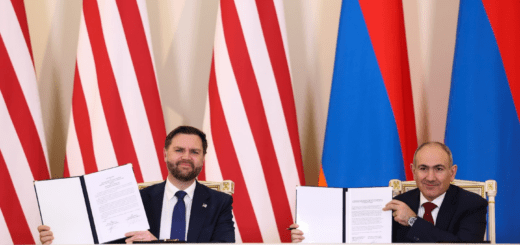
No matter how many times Armenia’s Prime Minister Nikol Pashinyan claims that he has brought peace to Armenia — just as he claims to have brought democracy — the fact remains that not only there is no peace; there is not even a signed worthless “Peace Treaty.”
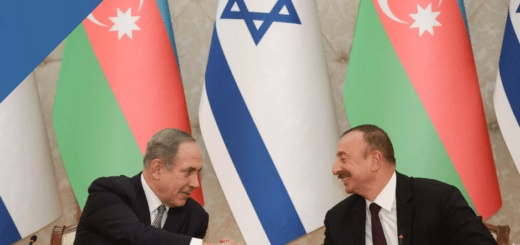
It is alarming that Armenia’s leader has become the darling of Azerbaijan and Turkey. Both of these countries, along with Europe and the United States, are doing everything they can to ensure that after this June’s Parliamentary elections, Pashinyan remains in power. The last thing they want is an Armenian nationalist replacing him, wiping out all of their gains in the last eight years. That is why we constantly hear from Turkish President Recep Tayyip Erdogan and his cronies that they have no problems with Pashinyan, but are very concerned about the “radical” Diaspora.
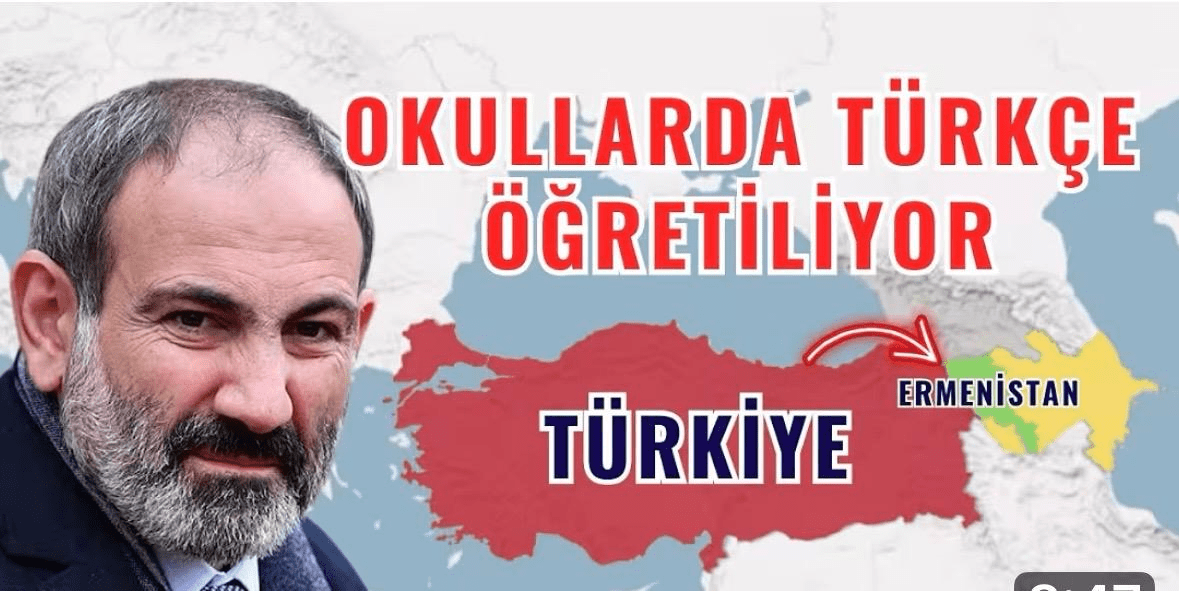
The latest evidence of this sad state of affairs is an 8.5-minute long YouTube video in Turkish titled: “They are teaching Turkish in [Armenia’s] schools.” The video, prepared by Turkish blogger Erencan Algun, has been viewed 85,000 times in the last 10 days and has over 600 comments.
Algun, who has close to 200,000 followers, stated: “Why is Armenia becoming friendly with Turkey? Turkish is being taught in schools! Could Armenia be gradually shedding its animosity towards Turkey? Let’s look at this issue through Pashinyan’s statements. Last summer, he said: ‘Our only option is to reconcile with Turkey. To go to war with a country like Turkey? They don’t know what they’re talking about.’ Furthermore, ‘Turkey and Armenia do not pose a threat to each other. Our proposed Peace Crossroads project is not an obstacle to the Turan path. If there is a waterway, we can all drink this water together,’ he stated. Shortly after these statements, Trump intervened, renaming the famous Zangezur Corridor the Trump Corridor and granting the US a 100-year lease in the region…. How effective Pashinyan’s peace-themed words are in society and how Armenia is advancing this process?”
Indeed, Armenia’s Minister of Education has announced that 400 high schools in Armenia have expressed an interest in learning the Azeri and Turkish languages. However, the minister admitted, there is a shortage of qualified teachers in these languages. The next step would be bringing hundreds of Azeri and Turkish teachers to Armenia, creating a fertile ground for future spies. I would have been less concerned if these languages were taught in universities, not in high schools.
Algun continued: “Armenia’s political axis has begun to shift, and it has chosen a path of cooperation with the Turks…. In Armenia, ‘Turk,’ ‘Turkey’ and ‘Turkish’ are still emotionally charged words. The existence of Turkish as an elective course in Armenia does not fully mean that the two societies are getting closer. However, it is a sign that the two countries have stopped ignoring each other, and Pashinyan’s statements support this.”
Commenting on TRIPP — referred to by Azeris and Turks as a corridor, Algun said: “Zangezur is not only a transportation route between Azerbaijan and Armenia. It is also a strategic line connecting Turkey and Central Asia. When the Zangezur corridor opens, the seemingly disconnected Turkic states will be connected for the first time by an uninterrupted land route. This is not just a symbolic unification. Natural gas and oil pipelines can be laid along this route. Fiber optic internet cables will be installed. Direct rail transport will be established. Imagine, someone leaving Istanbul by bus and traveling through Iğdır, Nakhichevan, Zangezur, Karabakh, Ganja, and Baku, all the way to the Caspian coast. From there, they could take a ship to Kazakhstan, then a bus to Bishkek, or perhaps Urumqi [China]…. It’s more than just a route. It’s something like a reunification of civilizations. This vision is also called the Turan route, but because that term bothers some [Armenian] circles, the term ‘middle corridor’ is used diplomatically. So, what role will Armenia play in this process? The truth is Armenia can benefit from this corridor. If it acts wisely, its economy will be revitalized through this route because every truck passing through here will actually pass through Armenian borders. New revenue streams will open up, such as logistics revenue, service sector income, and customs revenue, and even attract new foreign investments.”
However, Algun acknowledged: “The burden of the past is so heavy that they [Armenians] can’t overcome certain emotions. Today, political rhetoric in Armenia still revolves around genocide, the loss of Karabakh, and Turkey being our enemy. Naturally, it doesn’t seem easy for a society that has grown up with this rhetoric to support the path of unity. Let’s see what time will show us. Let’s wait and see.”
In conclusion, Algun emphasized that the Trump Road “will benefit our country [Turkey] and Azerbaijan. In my opinion, it will provide not only transportation but also geopolitical expansion. This gains strategic significance both economically and militarily. And let’s not forget that Azerbaijan is a place where the Turkish Armed Forces are actively present. If this corridor opens, the influence of the Turkish Armed Forces in the east will increase even more. Therefore, Turkey plays a key role in this scenario. We just need to know how to play our cards right.”