Yerevan Vows to Fight to Prevent Genocides, Without Mentioning 1915 or Artsakh
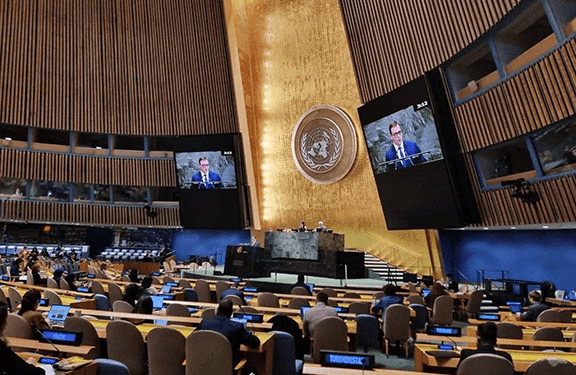
Deputy Foreign Minister Robert Abisoghomonyan addresses a UN panel on prevention of genocide on Dec. 9
A representative of official Yerevan on Tuesday told a United Nations gathering that the Armenian government continues to steadfastly fight for the prevention of genocides globally, yet in his remarks he neglected to mention the Armenian Genocide or the recent ethnic cleansing of Armenians in Artsakh, which is considered genocide by noted international scholars.
Speaking at an event marking the 10th anniversary of adoption of a measure to declare December 9 as the “International Day of Commemoration and Genocide Convention” at the UN, Armenia’s Deputy Foreign Minister Robert Abisoghomonyan made the pledge on behalf of the Armenian government.
“Armenia is strongly convinced that genocide prevention efforts should be grounded in systematic, institutionalized and coherent early warning and early action frameworks at local, regional and global levels. They need to be backed by solid legal, social and political mechanisms and supported with adequate resources,” Abisoghomonyan said in his remarks.
“There is a clear understanding of the risk factors that may lead to the commission of genocide, war crimes and crimes against humanity. There is broad agreement, reflected among others in the resolutions adopted by this august body as well as by the Human Rights Council, that gross violations of human rights and violations of international humanitarian law, incitement to violence and the spread of hate speech targeting protected groups should warrant a coordinated response. We know these risks; the real test is whether we act on them in time,” the deputy foreign minister emphasized.
“Genocide prevention has been at the center of Armenia’s multilateral agenda since our country regained its seat among sovereign nations,” Abishoghomonyan said.
“Today, we are fully determined to continue to accelerate actions, policies and partnerships to advance the cause of prevention, as a tribute to our past, as a duty towards victims of the ongoing wars and conflicts and as a promise for a future free from the odious scourge. Genocide prevention is not only a legal obligation; it is a test of our collective conscience. Let us ensure that “never again” becomes not a refrain of remembrance, but a principle of governance,” the deputy foreign minister stressed.
He also praised Raphael Lemkin who coined the phrase “genocide” and campaigned to establish the Genocide Convention, which legally defines the act.
“Lemkin gave the world a definition; our shared challenge is to give that definition full meaning through action,” Abisoghomonyan declared.
Ironically, it was Armenia that spearheaded the effort in 2015 to dedicate December 9 as “International Day of Commemoration and Genocide Convention” in the United Nations. Using the centennial of the Armenian Genocide as an opportunity, Armenia’s UN Ambassador at the time was able to garner almost unanimous support for the initiative.
Yet, Abisoghomonyan, in line with the Armenian government’s stated position that pursuing the international recognition of the Armenian Genocide was not a priority, did not once mention that event, which until today continues to be denied by the government of Turkey.
The deputy foreign minister also did not point to the systematic ethnic cleansing of Artsakh Armenians by Azerbaijan when he said, “ gross violations of human rights and violations of international humanitarian law, incitement to violence and the spread of hate speech targeting protected groups should warrant a coordinated response” in his speech.