Harutyun Marutyan’s New Book Published “Commemorating the Armenian Genocide”
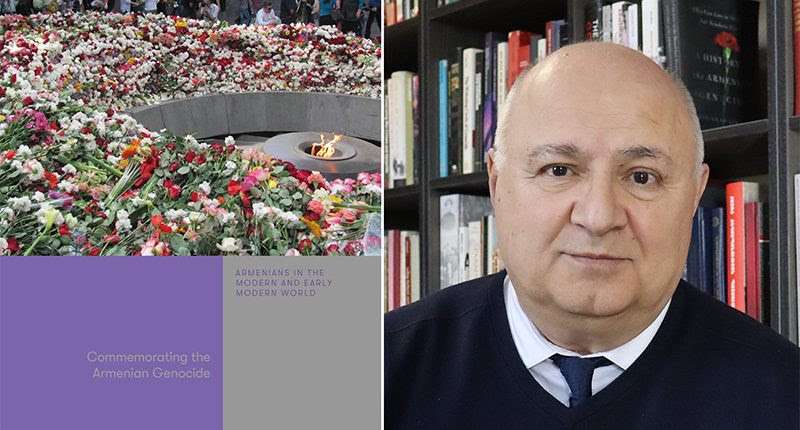
LONDON/NEW YORK—I. B. Tauris, an imprint of Bloomsbury Publishing, has announced the publication of Prof. Harutyun Marutyan’s Commemorating the Armenian Genocide. The book is part of the series Armenians in the Modern and Early Modern World edited by Bedross Der Matossian (University of Nebraska, Lincoln).
Commemorated annually on April 24, Armenian Genocide Remembrance Day is a vital part of national identity in both Armenia and the diaspora. This book offers a historical and anthropological perspective on how Armenians commemorate the genocide and how its significance has evolved over time. It begins with the first demonstrations by survivors in Allied-occupied Constantinople in 1919 and traces the fluctuations in the politics of the genocide and its official and popular memory during the Stalinist ban, the Khrushchev thaw, and beyond. The book also details the rituals of the annual march to the Armenian Genocide Memorial in Yerevan and other memorial sites, analyzing how the collective memory of this foundational event is embodied and continues to influence Armenian identity today.
Marutyan commented: “Since my school years, for more than half a century, I have visited the Armenian Genocide Memorial on April 24 every year to pay tribute to the memory of the innocent victims. Due to my profession, I eventually began to pay attention to people’s behavior, speech, and attire. I became interested in the question of when Armenians have been celebrating April 24, as well as the developments it has had in Armenia and the Diaspora over the course of a century. I have always been interested in the symbolism of the memorial complex as a whole, as well as its different parts. Existing research did not answer all the questions that interested me. And since I was already specializing in memory issues, I began to study these issues as well. As a result, I participated in several conferences with reports, articles were born, and, gradually, the idea of a monograph matured.”
According to Marutyan April 24 is not just a Remembrance Day for the victims of the Armenian Genocide. It is one of the most important and distinctive elements of Armenian identity, invisibly connecting and uniting all Armenians. The Remembrance Day has been shaped by many political twists and turns, and even a century later, its various interpretations are still widely discussed by social and professional circles. Commemorating the Genocide with an annual one-day event reflects and embodies the current state of society, serving as a summary of the realities, concepts, policies, and propaganda at a given moment. At the same time, honoring the victims of the Genocide does not depend solely on whether this day is observed.
For Marutyan, the memory of the Medz Yeghern has been subtly present in many forms in the survivors and their descendants, in the hearts of those who are aware of the Genocide. It is reflected in their speech, conversations, behaviors, attitudes, and actions throughout their lives. Discussing the significance of Remembrance Day involves examining the full range of ways in which the memory of the Genocide manifests. Since the issue is too broad for just one chapter, only a selection of topics are addressed here. However, the questions discussed aim to shed some light on the problem.
“This groundbreaking study on the commemoration of the Armenian Genocide, authored by one of Armenia’s leading anthropologists, represents a landmark contribution to the field,” said Der Matossian, editor of the series. “Marutyan’s book is the first comprehensive work to trace the evolution of genocide remembrance over the past century. Through an incisive analysis of the rituals, symbols, and commemorative language that have shaped public memory, the study offers innovative perspectives and opens new avenues for understanding how a nation constructs and transforms its collective remembrance,” he concluded.
Reviews
“Memory keeps a nation alive, Even if you cut off its heads, an Armenian poet wrote, the nation is like a hydra that will grow back many more. Anthropologist Harutyun Marutyan gives us a forgotten history of how Armenians around the world, and eventually in Soviet Armenia, remembered their martyrs in the Armenian Genocide of 1915. Commemoration is fundamental to the passing on of memory. Even the young architects who designed the Tsitsernakabert Monument to the Genocide did not know what the Yeghern (Genocide) was when they took up the task. In this beautifully written history, we learn how memory was transmitted for the last one hundred years, a story that has not hitherto been told. Like monuments and commemorations, this book is one of the transmitters that keeps the past alive in the present.” ¯Ronald Grigor Suny, author of “They Can Live in the Desert But Nowhere Else”: A History of the Armenian Genocide
“The monograph by the Armenian historian and former director of the Armenian Genocide Museum-Institute, Harutyun Marutyan, traces the changing course of Armenian remembrance culture and history politics with exceptional knowledge and from his own experience. It also explains the special features of Armenian commemorative rituals. Under Soviet rule, the (Eastern) Armenian settlement area that remained after the Ottoman genocide had to fight for decades for the right to self-determined remembrance. It was not until 1965 that Moscow allowed a memorial to be erected in Armenia’s capital, Yerevan. Since 1967, the impressive memorial has been the second pan-national place of remembrance in Armenia, alongside the Armenian Apostolic Catholicate in Echmiadzin. And it was not until 1988, almost at the end of Soviet rule, that the Soviet Armenian government dared to make April 24 (1915) a national day of remembrance and mourning. Today, recalling the darkest periods of Modern Armenian history constitutes an essential part of Armenian identity. As a descendant of Western Armenian genocide survivors, the author Harutyun Marutyan played a significant role in shaping this development.” ¯Tessa Hofmann, author; scholar of Armenian and genocide studies; Berlin
“Every group victimized by mass extermination expresses its pain and the trauma endured by the survivors and their descendants. When, moreover, this supreme crime has gone unpunished, as is the case in Turkey, the demand for justice becomes a central element of society. In this respect, Harutyun Marutyan’s study offers a comprehensive overview of the various forms of expression in Armenian society, which is still dominated by this legacy. His anthropological approach is masterly and will undoubtedly contribute to further reflection on the consequences of genocide.” ¯Raymond Kévorkian, Director of Research Emeritus, Université Paris VIII, Saint-Denis, France
Copies of Commemorating the Armenian Genocide are available for purchase on the Bloomsbury Press website. Enter code GLR AT8 at the checkout on bloomsbury.com for 35% off.