Conditional Belonging: Armenians and the Lebanese ‘We’
By Edward Tashjian,
Keghart
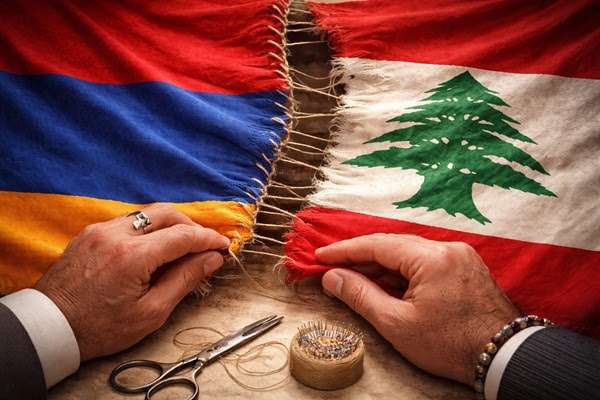
Armenians in Lebanon are not persecuted, marginalized, or openly rejected. They are liked, praised, even celebrated, yet they are not fully absorbed into the Lebanese “we.” The distance that remains is subtle, and therefore more durable.
In Lebanon, “we” is a complex and constantly shifting concept. There are many “we”s. It can refer to belonging to a sect, a political party, the residents of a city, or even a neighborhood. But beyond these partial groups, there exists one overarching “we” that ultimately binds the country together: the Lebanese Arab “we.” This “we” is primarily defined by language and a shared cultural-political identity.
Consider the Assyrian community in Lebanon. Like Armenians, Assyrians also possess an identity that extends beyond Lebanon. They regard Assyrians living in other countries as compatriots. The Lebanese Assyrian community was largely formed between 1915 and 1934 by Assyrians who survived genocide. Like Armenians, Assyrians largely remained neutral during the Lebanese Civil War.
Yet in Lebanon, Assyrians are Lebanese in the same sense as Maronites or Druze. Armenians are not.
If Assyrians and Armenians share similar histories, why is one considered part of the Lebanese “we” while the other is not? The crucial difference is language.
In Assyrian schools, the Assyrian language is allocated one hour per week. In Armenian schools, Armenian language instruction constitutes one of the pillars of the educational curriculum. For Assyrians, Arabic remains the primary language of public, social, and political life, integrating them into the Arab “we.” Ultimately, according to the Arab League—of which Lebanon is a member—an “Arab” is defined as a person whose first language is Arabic, who lives in an Arab country, and who sympathizes with the aspirations and causes of Arab peoples. For Armenians, Armenian dominates community life. Thus, unlike Assyrians, Armenians have preserved a linguistic distinction that keeps them outside Lebanon’s core Arab identity.
This article is not a moral accusation. It is merely a description showing how social belonging functions in Lebanon and how it appears in the most ordinary daily interactions. Through everyday expressions, I aim to show how people in Lebanon think about inclusion and identity.
Lebanon does not reject Armenians. That is precisely the problem. What exists instead is something far more stable and far more dangerous: Armenians are accepted conditionally, admired selectively, and spoken about as if they are next to Lebanon rather than of it. The evidence is not found in laws or slogans, but in everyday language, where societies reveal what they actually believe, often unconsciously.
This is not about individual intentions. It is about collective grammar. Not about what people mean, but about what their words structurally require in order to make sense. Take the seemingly harmless phrase: “We love Armenians.”
A couple of years ago, I was sitting in a café in Hamra with friends. During the conversation, someone learned for the first time that I am Armenian. Their response was immediate: “Ah, we love Armenians.”

Who is “we”?
Here, “we” does not refer to community belonging. The speaker is invoking the Lebanese Arab “we.” If that “we” means Lebanese people, then Armenians are clearly not included in it. No one says, “we love Shiites” or “we love Maronites.” That would be absurd, because those groups are already contained within the Lebanese “we.” You do not express love toward yourself as a collective. You express it toward an external group.
This is not semantic. It is a social ontology. Armenians are being positioned as a liked other, not as a constituent self.
Such reactions appear in unguarded moments, when people are not “performing” tolerance, but speaking instinctively.
During a taxi ride from Bourj Hammoud toward Hamra, passing through Mar Mikhael, a large Lebanese flag atop a well-known building came into view. The driver admired it. I mentioned casually that there was an Armenian institution in the building, the Kohar Library, and that they had placed the flag there. His response was immediate: “I know. The Lebanese didn’t do it. The Armenians did.”
Again, the sentence only works if Armenians are not fully Lebanese. Otherwise, it collapses into nonsense: “The Lebanese didn’t do it, but the Lebanese did.”
Try replacing “Armenian” with any other group—Shia, Sunni, Maronite—and the statement becomes unintelligible. Such a sentence would be incomprehensible because those groups are already part of the Lebanese “we.”
The most subtle form of Armenian exclusion appears in statements like: “Armenians are an added value to Lebanese society.”
Added value implies that the core already exists without you. You improve it, enhance it, and beautify it—but you are not foundational to it. This is the language used for migrants, investors, and NGOs. It is not the language used for constitutive groups.
No one says, “Shia are an added value to Lebanese society.”
No one says “Maronites are an added value.”
That would translate into absurdity: “Lebanese are an added value to Lebanese society.”
Armenians alone are framed as a supplement. Valuable? Yes. But not foundational. Appreciated, but not constitutive. Present, but not co-owning.
This is the architecture of conditional belonging.
Nowhere is this accidental. Lebanon’s confessional system is built on fixed political identities, inherited representation, and historically bounded categories of belonging. The nation is not imagined as a civic whole, but as a negotiated balance between recognized components. In such a system, groups are either constitutive or adjacent. Embedded or appended. Structural or supplemental.
Armenians were and are integrated into the system, but they were never considered foundational to it.
This produces a specific attitude toward them: trusted because they are seen as disciplined, praised because they are seen as productive, and respected because they are seen as politically contained. But not fully imagined as co-owners of the Lebanese project.
Of course, individuals transcend structures. Friendships erase boundaries. Families intermarry. Many Lebanese genuinely experience Armenians as fully Lebanese. But societies are not built from individual intentions. They are built from dominant patterns. And the dominant pattern remains linguistic, social, and structural distinction.
Lebanon knows how to tolerate Armenians.
It knows how to benefit from them.
It knows how to celebrate them.
What Lebanon has not yet managed to do is include Armenians within the shared Lebanese “we”—without footnotes, without qualifications, without grammatical distance.
And that matters.
Because what is merely praised can be withdrawn.
What is merely added can be removed.
What is merely called “brother” can still be treated as the “other” when crisis, fear, or scarcity enters the picture.
This is not about feelings.
It is about structure.
Armenians in Lebanon are not outsiders, but they are not fully insiders either. They exist in a suspended category: permanently present, permanently marked.
And until that changes, all the love in the world will remain what it currently is: a compliment and an exclusion all at the same time.
*****
 Edward Tashjian is a historian trained at the American University of Beirut. His work focuses on Middle Eastern and Armenian history and politics. His research engages the public through Badmatidaran, a digital project dedicated to Armenian history.”