8th Century BC Urartan Inscription Located in Today’s Azerbaijani Territory
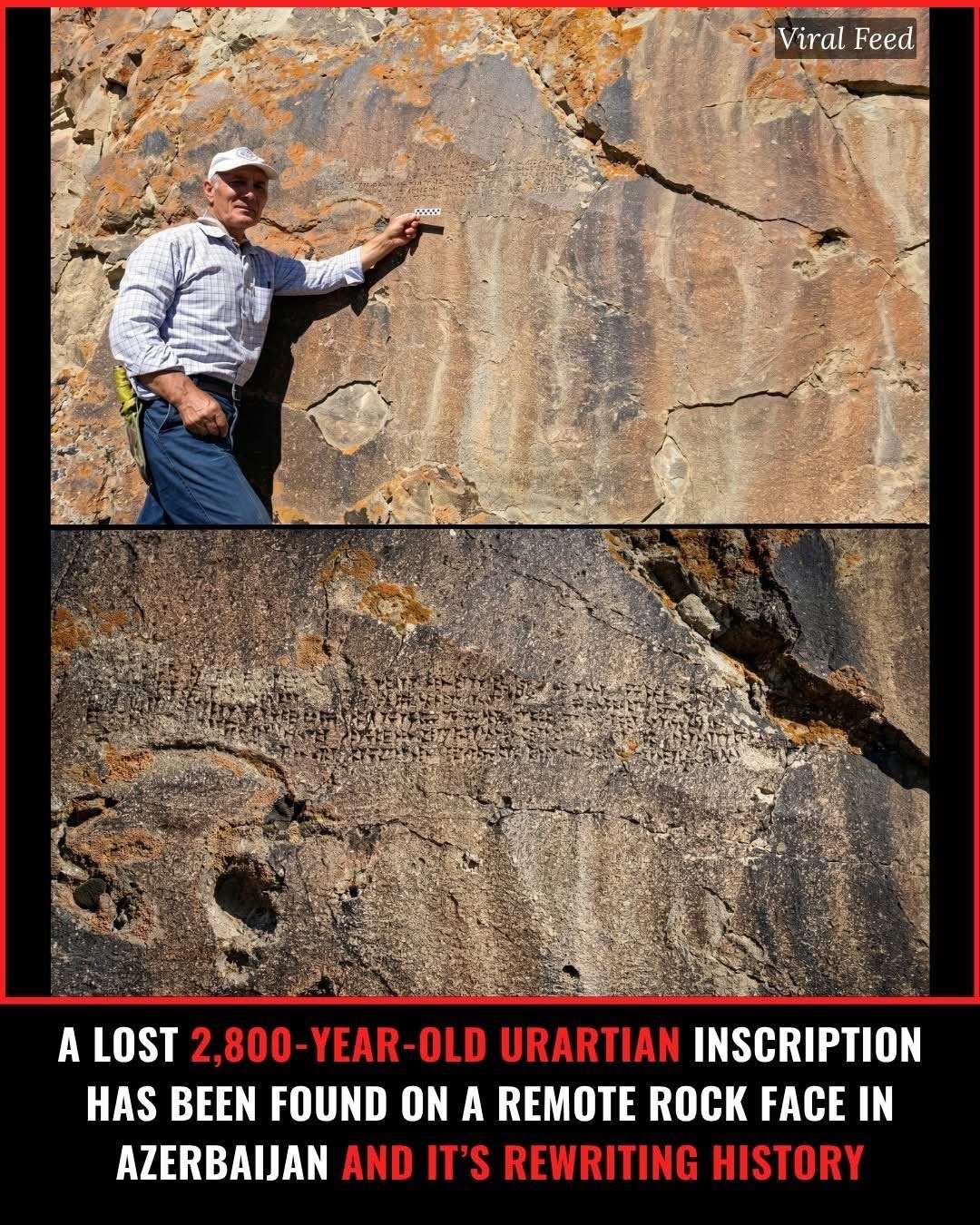
A Urartian cuneiform inscription carved into a rock face in Azerbaijan’s Nakhchivan region has been located by researchers, resolving a long‑standing question around one of the rarest Iron Age texts known from the South Caucasus.
The inscription, dated to the 8th century BC, records the names of the Urartian kings Ishpuini and Menua and refers to military victories, conquered cities, and a ritual offering made under the protection of the god Haldi.
According to the Azerbaijan National Academy of Sciences’ Institute of Archaeology and Anthropology, the text is considered the first known written example linked to Urartian culture found in Azerbaijan. The find is not a newly discovered text in the strict sense. The rock inscription in the Ilandagh area (also known as Ojasar‑Ilandagh) was first recorded in the late 1980s and entered academic circulation. But its exact location had not been clearly documented.For years, repeated attempts to locate the monument reportedly failed.
On June 1, 2026, a team of Azerbaijani researchers identified the site in the Ilandagh area. For archaeologists, a text without a secure location is only partly useful. Once the exact place is known, the inscription can be studied together with the terrain, nearby archaeological remains, routes of movement, and the wider political geography of the period.
The inscription mentions Ishpuini, son of Sarduri I, and Ishpuini’s son Menua — two rulers who belonged to the formative phase of the Kingdom of Urartu, one of the major Iron Age powers of the highlands around Lake Van, expanding across parts of eastern Anatolia, the South Caucasus, and northwestern Iran.
The existing translation states that “through the protection of the god Haldi,” Ishpuini and Menua conquered the city of Arshini, defeated its land, captured the land of Aniani, and destroyed it. The text also refers to setting up a stele for Haldi and a ritual in the land of Puluadi involving offerings to Haldi and the god’s wife. In Urartian royal inscriptions, Haldi stood at the center of kingship, warfare, and state ideology. Victory was framed as something granted under divine authority. The Ilandagh inscription therefore does more than name rulers and places — it preserves the political voice of an expanding Iron Age kingdom at the edge of its sphere of influence.
The rediscovery gives researchers a chance to revisit older readings with modern documentation methods: high‑resolution photography, 3D recording, mapping, and landscape survey could help clarify worn signs and place the monument within a broader archaeological setting. The Ilandagh inscription is especially important because it links Nakhchivan to the written political world of Urartu. In a region where many Iron Age societies are known mainly through material remains, a royal inscription gives names, actions, gods, and places. It turns the landscape into a historical document.