
More than 40 ancient ovens found inside a medieval castle in Armenia
by Dario Radley, Archeology MagazineMore than 40 vertical ovens have been found inside a medieval castle at Aruch in central Armenia. Known as tonirs, the ovens were built and rebuilt over several centuries as the castle changed into a place for daily life and work.
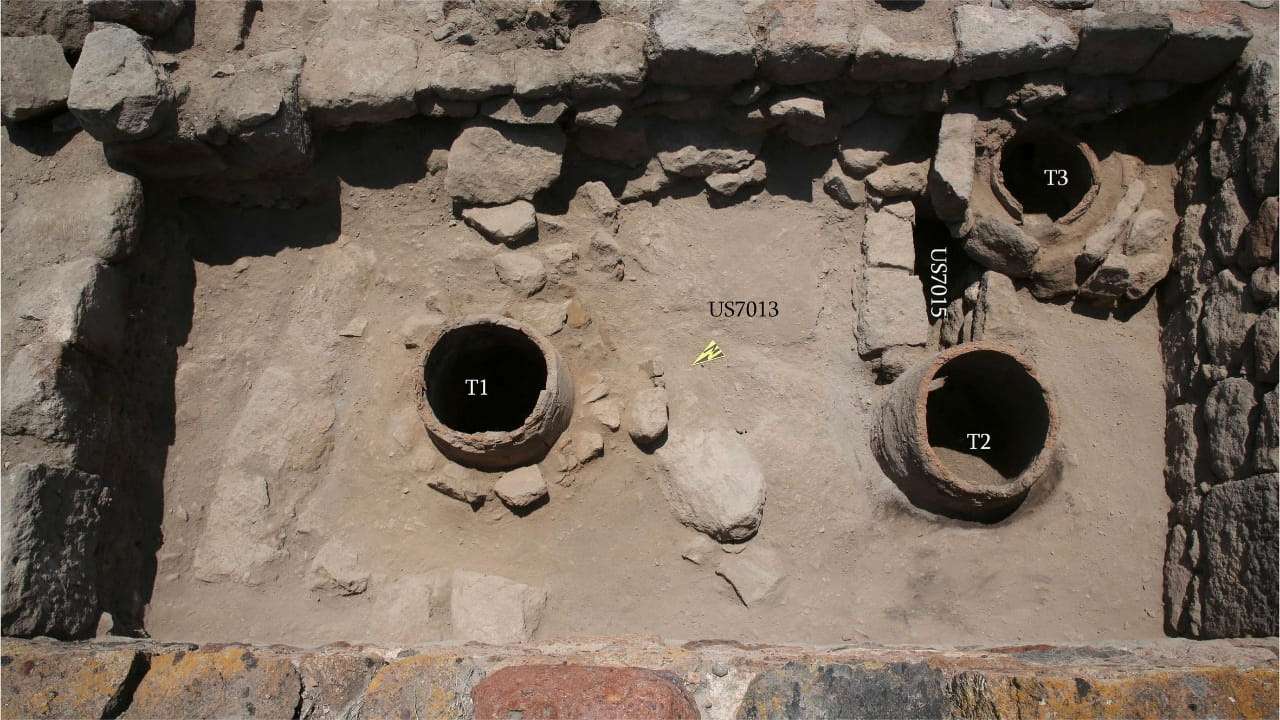
View south across Room 1B/10, showing three tonir installations and the associated ventilation channel. Credit: E. Fausti et al., Journal of Archaeological Science, Reports (2026), CC BY 4.0Archaeologists studied the ovens during excavations from 2022 to 2025 in Area 3, inside the high medieval castle. The team recorded the ovens alongside floors, walls, storage areas, pottery, animal remains and plant remains.
The large number of tonirs doesn’t mean more than 40 ovens were working at once. Most belong to later phases, from the late medieval period through the early modern and modern periods. Some were built after older ovens stopped working. Others were cut by later floors or covered by new walls.
Dated examples show how long the practice lasted. Tonirs 9 and 12 belong to the 14th and 15th centuries. Tonirs 2, 3 and 4 are linked mainly to deposits from the 17th and 18th centuries. Other ovens were used during the 19th and early 20th centuries.
General view of the castle and phased plan of Area 3, showing the principal architectural and occupational transformations from the High Middle Ages to the modern period. Credit: E. Fausti et al., Journal of Archaeological Science, Reports (2026)A tonir has a deep, vertical chamber with an opening at the top. Most were set partly or fully below floor level. A side channel near the bottom supplied air to the fire and helped control burning. The ovens were made from clay-rich material and often needed repair after repeated heating and cooling.
Food preparation appears to have been the main use of many ovens. Their form, cooking vessels, animal bones, ash, fuel remains and plant remains support this view. The ovens were suited to baking lavash, cooking food in vessels and roasting meat.
Plant remains also provide clues about fuel use. Samples from five tonir contexts contained cereals, fruits, crop waste, dung and other burned material. Tonirs 9 and 12 produced wheat, barley, millet, rice, rye, grapes and other fruits. Tonirs 2 and 4 contained large amounts of bovine dung with few seeds, pointing to cattle dung as a major fuel.
The remains don’t provide simple lists of foods cooked in each oven. Seeds, bones, ash and pottery could enter during firing, cleaning, refuse disposal, collapse or later filling. The study links these materials to wider food production and fuel management.
The ovens also show how people repeatedly changed the castle’s rooms. Several tonirs were placed in the same areas after earlier examples went out of use. New floors, walls and partitions later covered or cut through older installations. The pattern suggests continued use of favored work areas as room functions changed.
Modern Armenian households also provided comparison. Researchers observed ceramic and cement tonirs still used for lavash, meat and other foods. These observations helped explain oven construction, airflow, fire control and repair.
The researchers caution against treating modern customs as direct evidence for medieval Aruch. Historical and folk sources link the tonir with food, hospitality, household continuity and social cooperation. Such records help frame questions about past behavior, but don’t prove the same meanings existed at Aruch.
At Aruch, the tonirs record repeated cycles of construction, firing, cleaning, repair, replacement, abandonment and filling. Their remains show how food preparation and other heat-based work became part of the changing life of a medieval Armenian castle.
Publication: Fausti, E., Galanti, F., Ferdinandi, S., & Babajanyan, A. (2026). On the use of tonirs at the Aruch site (Republic of Armenia): archaeological evidence and ethnoarchaeological perspectives. Journal of Archaeological Science, Reports, 75(106023), 106023. doi:10.1016/j.jasrep.2026.106023