As Shushi’s Historic Cemetery is Razed for Sewer Pipes, Baku Insists it is Protecting Cultural Sites
Satellite image of the Eastern Cemetery in occupied Shushi (Azatutyun.am screenshot)
The U.S.-based Caucasus Heritage Watch recently documented with satellite imagery the destruction of a historic cemetery in occupied Shushi. According to the CHW, the site that was home to 12th- and 13th-century khachkars (cross stones) and historic gravestones was leveled, and a sewer line is now being laid through part of it.
Yet, Hikmet Hajiyev, a senior aide to Azerbaijan’s president, assured foreign diplomats accredited in Baku on Friday that his country’s laws protected cultural heritage in occupied Artsakh, despite wide-spread reports that Azerbaijan was systematically destroying Armenian religious and cultural heritage sites.
Hajiyev made the statement to the foreign diplomats who began a two-day tour of occupied Artsakh. Among them also traveling on this junket was Magdalena Grono, the European Union’s Special Representative to the South Caucasus, who was in Baku meeting government officials.
According to Azerbaijani media reports, the purpose of the trip to occupied Artsakh was to show construction and infrastructure projects across the region, after Azerbaijanis launched a brutal attack on Artsakh in 2023, forcibly displacing the Armenian population from its ancestral homeland.
“All cultural heritage in Karabakh and other territories of Azerbaijan is protected under the country’s legislation,” Hajiyev told the diplomats, despite mounting concerns from Armenian and international monitors over the preservation of Armenian historical and cultural monuments in occupied Artsakh.
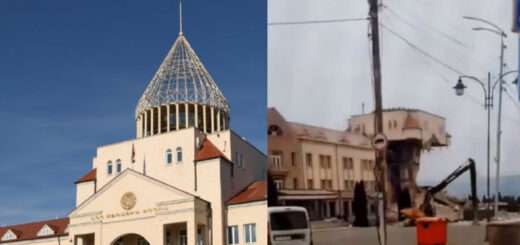
In April, CHW reported the complete destruction of Stepanakert’s main cathedral. In a rare comment about the matter, official Baku said that it was razing the religious sites built during what they called “Armenia’s occupation,” saying the church was built illegally.
 Satellite images from CHW show the before and after shots of the Eastern Cemetery in occupied Shushi
Meanwhile, the historical tombstones and 12th to 13th-century khachkars (cross-stones) of Shushi’s Eastern Cemetery have now been leveled to the ground. Azerbaijani authorities are currently laying sewer pipes across the site.
This historical cemetery in Shushi was not exclusively Armenian. High-ranking officials of the Russian Empire and Europeans also rested here. The tombstone of Sofia-Regina Reander—the daughter of a German professor—was also located here, the Caucasus Heritage Watch reported.
 Sophia Regina Reander’s tombstone (Monument Watch photo)
Slava Sargsyan, who has been working with Artsakh’s monuments for more than 50 years, learned of this latest instance of Azerbaijan destroying Armenian traces—as did many others—through documentation provided by the Caucasus Heritage Watch. Satellite imagery shows that the historical cemetery and khachkars are no longer there. Satellite imagery indicates that the historic cemetery in Shushi has been destroyed.
According to a monitoring group, the site was razed by bulldozers in May. The group noted that the tombstones and khachkars (cross-stones) had survived two centuries of history and numerous wars, yet they could not withstand the Azerbaijani reconstruction efforts in Shushi.
All the khachkars were documented and included in the registry of Artsakh’s monuments, the former head of the Department for the Protection of Monuments told Azatutyun.am. A year ago, Azerbaijan also leveled the Ghazanchetsots cemetery—which contained ancient tombstones—to the ground. That specific location was used for the construction of an opera house.
Hamlet Petrosyan, who holds Ph.D. in history and is a professor, had previously conducted excavations at the cemetery that was subsequently razed.
Residents of Shushi referred to it as the “Armenian-Russian” cemetery, although the tombstones reveal that individuals of other nationalities, in addition to Armenians and Russians, were buried there. Hamlet Petrosyan told Azatutyun.am that there were not three, but five khachkars at the site.
In April of this year, Baku razed the Stepanakert Cathedral and St. Hakob Church to the ground. Baku not only confirmed the action but also offered a justification: according to them, these two churches were “symbols of occupation.”
The only way to erase the Armenian presence from the villages and towns of Artsakh is to destroy everything through construction projects. That is precisely what the Azerbaijanis are doing and will continue to do, according to the historian.

 Petrosyan is the scientific director of the independent academic platform Monument Watch, and he no longer knows to whom—or for what purpose—these latest warnings regarding the destruction of historical monuments are being addressed.
Armenia has no intention of addressing the issue of Artsakh’s monuments, he said. One of Prime Minister Nikol Pashinyan’s arguments is the need be prudent, as such topics “are a double-edged sword.”
Petrosyan has no doubt that discussions and dialogue regarding the preservation of cultural heritage, as well as sounding the alarm, will pose no threat to the peace plan.