T’oros Roslin, the Zeyt’un Gospels, and the legal stewardship of Armenian heritage
By: Karén Tonoyan
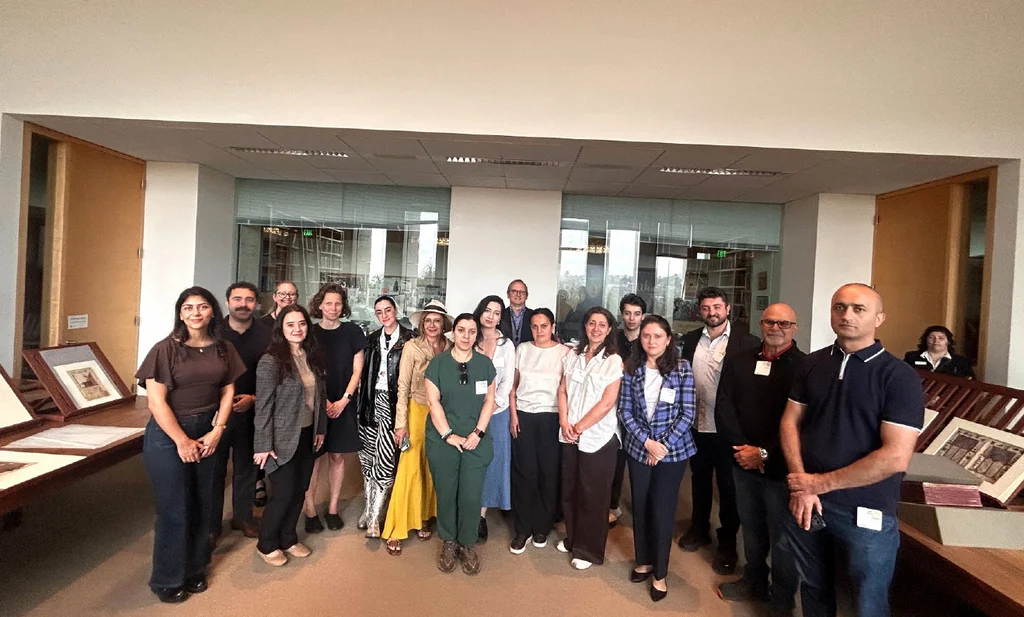
ArmenBar members and guests during the October 2026 visit to the Getty Center’s Manuscripts Study Room.
It is one thing to study cultural property law in a classroom or a courtroom. It is quite another to stand before a work whose beauty, survival, and disputed journey embody the very questions lawyers are asked to resolve. That was the opportunity afforded to Armenian Bar Association members during a special Getty Center visit concluding the Association’s 2026 Midyear Meeting.
A Sunday in the manuscripts study room
The October 11 program, “Safeguarding Armenian Provenance in Museums,” took members behind the scenes for a private viewing of Armenian manuscripts. In the Getty’s Manuscripts Study Room, guests gathered around exceptionally delicate works while museum staff carefully turned pages and lifted protective coverings. The colors, fine brushwork, and gold leaf, so difficult to appreciate in reproduction, were striking at close range.
Stephen W. Clark, the Getty’s vice president and general counsel, welcomed his fellow members of the legal profession and offered a rare view of the institution from counsel’s perspective. His remarks connected a museum’s everyday legal responsibilities, including intellectual property, governance, transactions, and construction, with the particularly sensitive questions raised by ownership and provenance disputes. Such matters implicate evidence and legal rights, but also institutional responsibility and public trust.

ArmenBar visitors gather for remarks in the Getty’s Manuscripts Study Room, surrounded by objects presented for close study.
Assistant Curator Orsolya (“Orsi”) Mednyanszky, together with curatorial colleagues, guided members through the history and artistry of the featured objects. She emphasized the importance of making Armenian cultural heritage accessible both to the Armenian community and to visitors who may be encountering this artistic tradition for the first time.
The manuscript at the heart of the visit
The centerpiece was a group of richly illuminated Canon Tables from the Zeyt’un Gospels, completed in 1256 by T’oros Roslin in Hromklay, in the Armenian Kingdom of Cilicia, for Catholicos Constantine I. This is Roslin’s earliest dated and signed work. The main Gospel book is held today at the Matenadaran in Yerevan; the detached Canon Tables are in the Getty’s collection.
Canon Tables were ingenious scholarly tools: columns of references enabled readers to compare corresponding passages across the four Gospels. Yet Roslin transformed these practical cross-references into a visual world of intricate architecture, peacocks, roosters, birds, pomegranates, palms, luminous pigments, and gold. As the curator explained, their decoration was also devotional. The images invited contemplation before the reader entered the sacred text.

Roslin’s illuminated Canon Tables (1256), with Gospel cross-references framed by birds, plants, and intricate ornament. Photograph from the Getty study-room viewing.
The physical experience made the work’s significance more immediate. The leaves are not merely examples of medieval craftsmanship; they are evidence of an Armenian tradition of scholarship, faith, patronage, and artistic innovation that endured long after the political world in which the manuscript was made had disappeared.
A provenance story that became a legal case
The Zeyt’un Gospels survived the devastation and displacement associated with the Armenian Genocide and its aftermath. During that turbulent period, the illuminated Canon Tables were separated from the rest of the manuscript. The circumstances of the separation and the subsequent chain of custody became central to the later controversy. The surviving Gospel volume ultimately reached Armenia, while the detached leaves moved through private hands before the Getty acquired them in 1994.
1256 | Roslin completes the Gospels at Hromklay for Catholicos Constantine I.
1915–1920s | The manuscript survives upheaval and displacement; its Canon Tables become separated.
1994 | The Getty acquires the detached Canon Tables from private collectors.
2010 | The Western Prelacy of the Armenian Apostolic Church of America brings a restitution suit in California.
2015 | The parties reach a settlement recognizing Church ownership and arranging for the leaves to remain at the Getty through a Church donation.
The lawsuit raised issues familiar to cultural property practitioners: proof of historical title, contested provenance, statutes of limitation, the passage of time, and the difficulties of seeking restitution across generations and jurisdictions. The legal dispute was brought by the Western Prelacy, not by the Armenian Bar Association. Its outcome was a negotiated agreement rather than a judicial determination on the merits.

An Armenian manuscript binding examined during the visit. Physical conservation is inseparable from provenance and cultural stewardship.
The 2015 resolution: recognition, donation, and access
In September 2015, the Getty and the Western Prelacy announced an agreement. The Getty acknowledged the Armenian Apostolic Church’s ownership of the Canon Tables; the Church, in turn, agreed to donate the pages to the Getty, where they would continue to be conserved, studied, and made accessible. The Getty identifies the object as a gift of the Catholicosate of the Great House of Cilicia.
That distinction is instrumental for properly understanding the outcome. The agreement should not be described as a court-ordered return, a judicial finding of wrongdoing, or a physical reunion of the leaves with the volume in Yerevan. It did, however, achieve a meaningful recognition of historical ownership while establishing a framework for continuing preservation and public engagement. The manuscript’s story now lives in both places, with the original Gospel in Armenia and its separated Canon Tables in Los Angeles.
Scholar Heghnar Zeitlian Watenpaugh has illuminated the manuscript’s extraordinary modern history in her research and book, The Missing Pages. Her description of the Gospels as a “survivor object” captures why legal provenance is inseparable from the memories of the families and communities who protected Armenian sacred objects through catastrophe.
More than one extraordinary manuscript
The special viewing offered a wider perspective on Armenian manuscript culture. Members examined a sumptuous seventeenth-century Bible from New Julfa, the Armenian community in Isfahan. Its gold-rich illuminations and depiction of King Solomon as a scribe speak to the prosperity, craftsmanship, and religious life that Armenians rebuilt far from their ancestral homes. Its Canon Tables also revealed the lasting influence of Roslin’s visual language centuries later.

An illuminated opening from the 1636 Armenian Bible of New Julfa (Isfahan), showing the enduring vocabulary of Armenian manuscript art.
A leaf from an Armenian Alexander Romance illustrated the meeting of historical legend, literary imagination, and Christian commentary. Scenes of Alexander’s poisoning and Roxana’s farewell reminded visitors that manuscript culture extended well beyond liturgical texts.

An Armenian Alexander Romance leaf depicting Alexander’s poisoning and Roxana’s sorrowful farewell. Photograph from the Getty visit.
Another moving example was a Gospel associated with Mesrop of Khizan. Curators discussed the difficulty of reconstructing a dispersed manuscript and the essential role of early photographs in identifying leaves that have resurfaced. Four leaves have been reunited with the Getty volume, three are known to be at the Chester Beatty in Dublin, and others remain unaccounted for. The museum welcomed information that might help trace them. The lesson was unmistakable: preservation is ongoing detective work, and documentary evidence can be as important as the objects themselves.
What Armenian Bar members can take from the visit
- Provenance is a legal question and a human story. Ownership evidence, wartime displacement, family memory, and cultural identity often have to be understood together.
- Settlement can serve several forms of justice. The Zeyt’un agreement illustrates how acknowledgment of title, preservation, access, and institutional cooperation may intersect, without creating a court precedent.
- Documentation is indispensable. Colophons, archival photographs, acquisition histories, and digitized collections can help establish identity, reconstruct provenance, and reconnect dispersed heritage.
- Stewardship remains unfinished. Getty staff expressed interest in the possibility of future reunification efforts, including digital approaches, but did not announce a physical reunion or exhibition commitment.
ArmenBar’s connection, and the work ahead
The Armenian Bar Association has followed the Zeyt’un Gospels story for years. Its Winter 2015 newsletter discussed the eight “orphan” pages, and the 2026 Midyear program returned members to the subject through direct engagement with the objects, curators, and the Getty’s legal leadership. This was an educational encounter consistent with the Association’s broader interest in Armenian cultural heritage, historical accountability, and the rule of law. It should not be mistaken for participation as counsel in the original case.
The visit also suggested constructive avenues for continued attention: sharing authoritative scholarship and museum image resources with members; supporting informed discussion of provenance and cultural property practice; identifying credible archival leads when lost manuscript leaves emerge; and exploring how digitization might help reconnect works whose physical parts are held by different institutions. These are opportunities for consideration, not projects or commitments formally announced by ArmenBar or the Getty during the visit.
Perhaps the strongest takeaway is that the law’s contribution to cultural heritage extends beyond litigation. It also includes careful historical inquiry, principled dialogue, transparent institutional practice, and the patient work of ensuring that a people’s cultural record remains visible, legible, and accessible to future generations.

Members discuss illuminated manuscripts with the Getty’s curatorial team during the special study-room viewing