A Place of Greater Safety
In granting their prime minister a third term, Armenians have embarked on a bold historic gamble to align their country with Turkey and the West.
By Evan Pheiffer, Lareviewofbooks.org
If we are what we eat, then Turks and Armenians are an anomalous kind of foe. The writer Meline Toumani dismisses these cultural overlaps as the “narcissism of small similarities.” But others disagree. In his masterpiece Passage to Ararat (1975), Michael J. Arlen recounts a sadder truth. “Do you know what I think was worst about the trouble with the Turks?” a man in Yerevan asks him. “It was that the Turks and the Armenians were brothers.” “But I thought the Turks hated the Armenians,” says Arlen. “Don’t brothers sometimes hate one another?” he replies.
In handing Prime Minister Nikol Pashinyan a historic win in the June parliamentary elections, Armenians have boldly opted to give their tortured brotherhood with Turkey another try. With a slim majority, Pashinyan’s Civil Contract party now has a firm mandate to finalize peace with Azerbaijan, normalize ties with the Turkish government in Ankara, draw closer to the United States and European Union, and release itself from the cold and calculating embrace of Mother Russia. Most crucial of all, he promises to fully open the land border with Turkey for the first time in over three decades.
It was an impressive victory for a leader who presided over two disastrous military defeats. First was the loss in 2020 of most of the territory Armenia held in and around Nagorno-Karabakh, a mountainous enclave in Azerbaijan inhabited by ethnic Armenians. Given by Stalin to the Azerbaijani SSR in 1921, the autonomous oblast became the scene of a ferocious struggle in the late 1980s as Karabakh Armenians clamored for unification with Armenia under the intoxicating spell of Mikhail Gorbachev’s lethal attempt to liberalize the USSR with glasnost and perestroika. Mass protests soon morphed into conflict. Armenian forces proved victorious by 1994, capturing not just Karabakh but also seven surrounding districts they ethnically cleansed to serve as buffer zones.
Pashinyan’s second great defeat was the loss of the rest of Nagorno-Karabakh itself in a lightning two-day strike in 2023, despite the presence of 2,000 Russian peacekeepers and vague security guarantees from Moscow. In this two-stage reconquest of Nagorno-Karabakh, Azerbaijan had considerable assistance from Turkey, Israel, and thousands of Syrian mercenaries. In the aftermath, Nagorno-Karabakh’s 120,000 ethnic Armenians were forced to emigrate en masse, ending centuries of Armenian existence in this mercilessly beautiful region.
Saro, a 60-year-old tour guide, is one of them. “I’m three times a refugee!” he tells me over tea and apricot brandy in the courtyard of a derelict mosque in Yerevan. “First from Baku, then Shushi, now Stepanakert.” His peregrinations trace the implosion of the South Caucasus. After anti-Armenian riots exploded in the industrial Caspian Sea city of Sumgait in 1988, a first wave of Armenians fled Azerbaijan. By 1990, 200,000 had been forced out of Baku alone. Saro, for his part, moved to Shushi, a highly contested city in Karabakh, after its capture by Armenian forces in 1992. He settled into a heavily war-damaged 19th-century mansion built by Muslim notables where he hosted diaspora Armenians (and this writer) until the city’s recapture in 2020.
After Shushi’s fall, Saro moved down the hill to Stepanakert, capital of the now-defunct Artsakh Republic, as Nagorno-Karabakh was known in Armenian during its 30-year existence. When that fell in 2023, he moved to Yerevan. Stepanakert, for its part, has now reverted to its Azerbaijani name of Khankendi. To christen its recapture, the Holy Mother of God Cathedral, completed in 2019, was demolished on the down-low in April.
I ask Saro if anyone had stayed behind. “Only crazy folks and alcoholics,” he concedes. “Along with one eccentric who vowed to hide and take his revenge on Azerbaijan single-handedly.” How is that going? “He made a few blunders in Baku and is now holing up in Yerevan. But no one can stand him here either!” For a man constantly being exiled, Saro is surprisingly cheerful. “Don’t you worry,” he smiles. “We’ll get Karabakh back before long.” He reminds me of an optimistic fellow I met in Stepanakert a decade ago. “We could take Baku by Friday if we wanted!”
A proud atheist, Saro speaks mostly Russian with his wife, another Armenian from Baku. “It was never about religion,” he says of the conflict that saw up to 250,000 Azerbaijanis ethnically cleansed from Armenia. “Anyway, Aliyev’s not even Azeri!” a reference to Azerbaijani president Ilham Aliyev. “He’s a Kurd from Nakhchivan,” the noncontiguous province of Azerbaijan pinched between Turkey, Armenia, and Iran. It’s a remark typical for a region in which ethnicities are a constant matter of discussion. Many are eager to remind you that Recep Tayyip Erdoğan is a Georgian (which Erdoğan first admitted and later denied) and Pashinyan a closeted Turk (this is meant as an insult; Pashinyan was born in Armenia).
Unsurprisingly, the Russian propaganda machine was in full swing before the election. “If Pashinyan wins, he’ll let all the Azerbaijanis back in,” laments Saro. “That will be the end of us. We’ll all be forced to move to Russia or America.” For once in concert with Europe, Washington also weighed in, siding with Pashinyan. In addition to vocal endorsements from President Donald Trump and Vice President J. D. Vance, Secretary of State Marco Rubio flew out in late May to sign a minerals deal and stump for a joint transport corridor in partnership with Turkey and Azerbaijan.
“Armenia is heading toward disaster, and Pashinyan is leading it there!” laments Sevan, a 69-year-old Turkish Armenian writer in Yerevan. “His sole foreign policy is ‘Please be nice to me, Turkey.’ But that’s not how international relations works! Last year, Turkey asked Armenia to remove Mount Ararat,” the 5,137-meter national symbol that towers over Yerevan from the wrong side of the border, “from its passport stamp. And he did it!” In line with his “Real Armenia” campaign to oppose the fixation on “Historical Armenia,” Pashinyan is now trying to replace Ararat with Mount Aragats, a less imposing peak on this side of the border, as the national icon.
:quality(75)/https%3A%2F%2Fassets.lareviewofbooks.org%2Fuploads%2FEvan%20Pheiffer%201F7A1229%20A%20house%20along%20the%20Turkish-Armenian%20border%20overlooking%20the%20Arpac%CC%A7ay%20Dam.jpg)
A house along the Turkish-Armenian border overlooking the Arpaçay Dam.
“This is absurd!” says Sevan, who’s had his own share of run-ins with the Turkish state. An Istanbul polymath who escaped from Turkish prison in 2017, he sought asylum in Greece and Montenegro for nearly a decade before moving to Yerevan last year. “What will be next?” he exclaims in dismay. “What if the Turks want to take control of the airport? Or stop us from teaching Armenian history in local universities? This was a test run for how much humiliation the country is willing to endure,” he adds. “And we miserably failed it.”
The inference is that only Russia can protect this mountainous statelet of roughly three million souls. The problem is that Russia is also on the ropes. “Look at what happened to Syria, then Venezuela, and now Cuba,” laments Sevan. “Russia can’t protect her allies: one by one, they’re falling. Pashinyan’s aim is to prevent Armenia’s collapse, which is understandable,” he concedes. “Any other leader would have done the same. But the problem is that Armenia was created by Russia and needs its protection. It can never survive on its own surrounded by hostile enemies.”
¤
If only its enemies weren’t always evolving. Vladimir Putin, for example, has threatened the Belgium-sized country with a “Ukrainian scenario” if it takes its occidental flirtation any further. For good measure, he also restricted the import of Armenian brandy, sparkling water, cucumbers, tomatoes, strawberries, grapes, cherries, and apricots. Contra Pashinyan, the opposition vowed to restore Armenia’s historic place under Russian tutelage. “Russia accounts for 46 percent of our economy!” says Saro, citing a credible figure. “There’s no way we can disentangle ourselves.” Like those afraid to leave an abusive partner, many would prefer the devil they know.
If Russia’s power has declined since its invasion of Ukraine, Armenia has still done well out of the new sanctions economy. “There are 40,000 Russians in Yerevan,” says Sevan, giving what’s likely a conservative estimate. “Many of them live in this neighborhood,” a posh quarter near Missak Manouchian Park. “Anyone importing anything to Russia has to go through here, Georgia, or Kazakhstan. On paper, at least,” he adds. “Most of the goods in question never enter the country.” In return for 10 percent of the proceeds? “Try 50 percent! Why do you think you see all these fancy new cars and restaurants? Many people have gotten much richer here since 2022.”
Who ran against Pashinyan? The foremost candidate was Samvel Karapetyan, a billionaire Russian Armenian property developer and patron of the Armenian Apostolic Church who has been under house arrest since June 2025. Next was Robert Kocharyan, architect of the Armenian seizure of Nagorno-Karabakh; though he was once a war hero, his greatest legacy is his failure to secure a lasting peace as president and prime minister in the 1990s and 2000s. Another candidate was the thick-necked Gagik Tsarukyan, a world arm-wrestling champion turned brandy tycoon who is building the country’s largest hilltop statue of Jesus. The fourth major candidate was Hayk Marutyan, an actor and comedian who served as mayor of Yerevan between 2018 and 2021.
“I don’t love Pashinyan at all, but all the alternatives were garbage,” says Hasmik, a 34-year-old Armenian from Tbilisi, Georgia, whose family moved to Los Angeles in the 1990s. “We lost Artsakh on his watch, which in most countries would automatically mean losing the next elections. But people see the past leaders as more corrupt and morally bankrupt,” she adds. “And at least Armenia is more attractive to investors now that the conflict is over.”
:quality(75)/https%3A%2F%2Fassets.lareviewofbooks.org%2Fuploads%2FEvan%20Pheiffer%201F7A1206%20Pashinyan%20%E2%80%98Real%20Armenia%E2%80%99%20campaign%20poster%20in%20Gyumri.jpg)
Pashinyan “Real Armenia” campaign poster in Gyumri.
Armen, a 25-year-old from Gyumri, Armenia’s second-largest city, agrees. Captured by Azerbaijani forces during the 2020 war, he was scarred by the conflict. “If you would have met me four or five years ago, I was probably clinically insane,” he admits. Yet he’s remarkably good-natured given what he’s gone through. “What’s that proverb about time healing all whatchamacallits?” He even speaks warmly of the Azerbaijanis that captured him. “We’d trade our inedible canned food for Turkish cigarettes,” he recalls. “They’re not so different from us: some of them even loved anime! I’m an atheist,” he adds, “but I pray I didn’t kill any of them.”
During the 44-Day War in 2020, one of his jobs was to carry the dead and wounded from the battlefield. I ask if he met any of the foreign mercenaries that fought in droves for Azerbaijan. “Only as corpses.” Does he keep in touch with any of his former comrades? “Just one,” he says. “He was a genius of a kind. Imagine the mind it takes to shoot down Turkish and Israeli drones with 1960s Soviet antiaircraft missiles! Now he’s in Moscow, doing something in IT. If a tenth of us had been half as clever, we wouldn’t have lost the war,” he sighs. “One of the reasons casualties were so high on both sides was that too few of us—on either side—knew how to fire a weapon.”
¤
The demographic most likely to support Pashinyan and opening the border is young men. After all, they have borne the overwhelming brunt of a conflict wrought by their elders. Since 2016 alone, around 5,000 Armenian men have perished in the conflict, with the average age of the fallen being 22. As in cities and towns across Azerbaijan, their faces adorn the walls of every neighborhood. In a country with 12 percent unemployment and a minimum wage of $200 per month, no one stands to benefit more from normalization with Turkey. “We just want peace!” say Ashot and Grigor, two twentysomethings in Yerevan. “It’s been 30 years of war. We’re sick and tired of it.”
:quality(75)/https%3A%2F%2Fassets.lareviewofbooks.org%2Fuploads%2FEvan%20Pheiffer%201F7A1305%20Tomb%20of%20a%20fallen%20soldier%20near%20the%20Turkish%20border%2C%20with%20Mount%20Ararat%20looming%20in%20the%20distance.jpg)
Tomb of a fallen soldier near the Turkish border, with Mount Ararat looming in the distance.
I drive to one of the country’s two border crossings with Turkey to take the temperature. “Of course I want it to open,” says Artun, a 29-year-old who runs the only döner shop in Akhurik, a village of 1,200 people about 10 kilometers southwest of Gyumri. “And so does the rest of the village.” Does he think it finally will? “Fifty-fifty.” Who wouldn’t want it to open? “Russia!” Why not? “Because Russia doesn’t benefit from Armenia’s prosperity.”
I drive the last kilometer down a bumpy dirt road to see if any of the border guards care to comment. A polite young soldier phones his superior, after which an SUV comes careening from the base to assess the intruder. He asks for my papers and dictates into his phone. “No beet muttons for sale on Sunday,” it mistakenly reads. He tries again. “This is a militarized border zone that’s forbidden to approach, cross, photograph, or pursue touristic activities in.” I ask to borrow his phone to type a question. Would he like the border to open? “That is for the government of Armenia to decide,” he peremptorily types. “But personally I have no objections.”
A moment later, a young Russian officer in sky blue and green fatigues comes speeding out to take stock of the situation. A baby-faced man of Central Asian origin, he barks several orders in Russian, takes a picture of my license plate, and hurries back to base. Looming in the distance is a sun-drenched billboard showing the Armenian and Russian flags in an embrace. Behind it, the vast green empty steppe of Eastern Turkey, Northern Kurdistan, or Western Armenia, depending on whom you’re asking.
A few miles south, I meet Zhenia, a 26-year-old from the border village of Anipemza. She’s rightfully proud of her English. “Welcome!” she beams. “You can call me Jenny.” In addition to housing an elementary school and the ruins of a fifth-century basilica, her village is unique for its size: instead of the small, gray single-family homes that dot the Armenian countryside, this settlement of 300 souls is mostly made up of complexes resembling Khrushchevkas, the functionalist concrete-paneled apartment blocks that once housed an estimated 127 million Soviet citizens.
Overlooking a steep gorge of the Arpaçay River that divides Turkey from Armenia, Anipemza is within shouting distance of the Kurdish shepherds who bring their flocks to graze on the other side of its verdant slopes. “Merhaba!” Jenny shouts to one of them. “Those are my good Kurdish friends,” she adds gleefully. “Look, I have their phone number—I can call them anytime!” She’s also on good terms with the Russian soldiers who live in Anipemza’s small barracks. After all, it’s an old tradition. At the end of her street is a small khachkar (cross-stone) commemorating Russian Armenian friendship. Instead of a cross, it’s inscribed with the years 1915, 1941, 1945, and 1988 and the word “Remember.”
:quality(75)/https%3A%2F%2Fassets.lareviewofbooks.org%2Fuploads%2FEvan%20Pheiffer%201F7A1272-2%20Commemorative%20khachkar%20to%20Russian-Armenian%20friendship.jpg)
Commemorative khachkar to Russian-Armenian friendship.
Jenny invites me in for tea. Her father, a teacher who lived in Russia and Ukraine for 20 years, is on the couch. Missing his right leg, he has a crutch, an ashtray, and a pack of Akhtamars, the national cigarette named after the ancient monastery on Lake Van (in Turkey). The only image on the wall is a portrait of his bare-chested father from the 1950s, a local wrestling champion. “We are strong people!” says Jenny. It turns out she’s not the only one learning Turkish. Her 10-year-old sister has been studying it through ChatGPT. “We would love to visit Western Armenia”—that is, Eastern Anatolia. “Kars is right there!” she says, pointing across the gorge. “Erzurum there! And Digor there!”—three cities of considerable importance to Turks, Kurds, and Armenians.
Despite her friendly and open demeanor, Jenny has no desire for the border to open. On this she’s very adamant. “I’d rather die than see it open!” she declares. “Last year, I met two Turkish people who were very kind to me. But then they said: ‘Let’s put the past behind us and forget about everything. Let’s delete it and move on with our lives.’ This is unacceptable!” she exclaims. “I will never forget. It’s not possible! My place is not to forget, but to remember. So long as Turkey doesn’t remember, we can’t allow the border to open.”
:quality(75)/https%3A%2F%2Fassets.lareviewofbooks.org%2Fuploads%2FEvan%20Pheiffer%201F7A1260%20Armenian%20border%20village%20facing%20Turkey%20across%20the%20river.jpg)
Armenian border village facing Turkey across the river.
Like many I spoke to, Jenny didn’t like any of the candidates in Sunday’s election. Nor is she happy with Pashinyan’s reconciliation attempts with Turkey. If she could improve one thing about her country, what would it be? “Better teachers! They’re teaching all kinds of crazy lies to our kids these days.” Like what? “That Turks are the good ones and Armenians the terrorists.” I say I don’t follow. That doesn’t sound like the narrative I would have expected. “You’re right!” she cries. “They’re trying to change the narrative! They’re trying to change the story. But we don’t want to change the story and we don’t want to change the narrative.”
¤
Outside the holy city of Etchmiadzin, where the Armenian Apostolic Church has had its Mother See since the fourth century, is the country’s other border crossing with Turkey, in the sleepy village of Margara. On a clear day, Mount Ararat looms majestically behind the heavily fortified compound whose gates open onto a quiet street of single-story homes. There is none of the usual hustle and bustle of border towns: no shops, money changers, liquor stores, fruit stands, gas stations, taxis, or minibuses. Amid a great dust storm, the streets are silent too. The only creatures stirring are a wheat-colored corgi and a little gray mutt having an early summer fling.
I stop at a supermarket a few kilometers away to take the local pulse. The young cashier is adamantly against opening the border but won’t say why. A friendly old man with a wondrously weathered face and combat fatigues also declines to answer, but he pats me on the back and smiles as he strolls away. An adolescent girl is on the fence about opening it. Her mother, in her early forties, is fully in favor, signaling so with a smile and two thumbs up. Armed with this sample size, I set off.
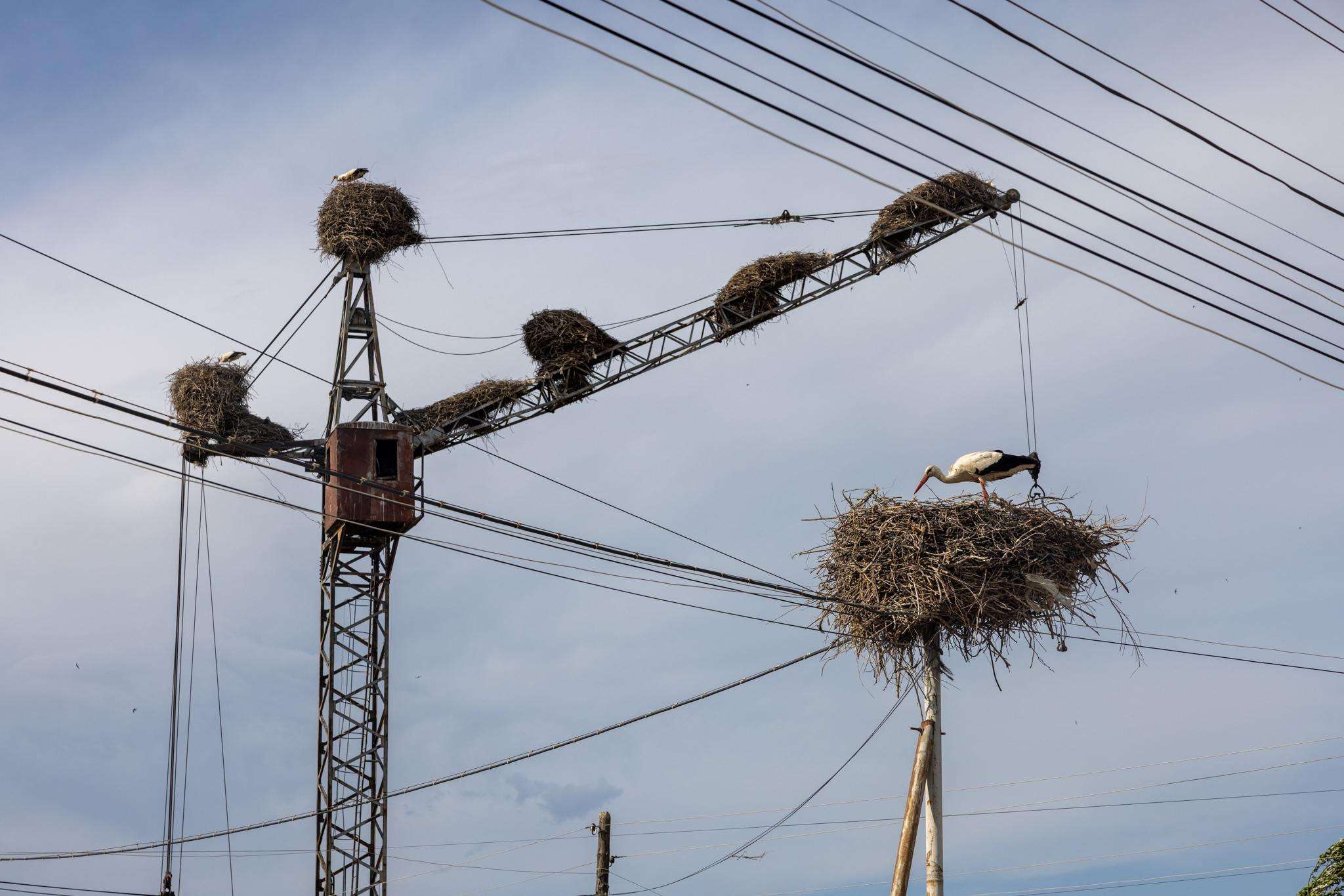
One of the most remarkable things about Armenia is its abundance of elaborate stork nests constructed atop utility poles, abandoned cranes, and other industrial relics of the Soviet era. Like Saint Simeon, these stylites hold hard and fast to their vertiginous habitations—proof, like Armenia, that where there’s a will, there’s a way. I pull over to take a picture. Avram, a jolly 63-year-old with a half-gold grill, emerges from a one-story building and invites me in for coffee. As luck would have it, he was working for Pashinyan’s campaign. Lilit, his 39-year-old colleague, is nervous about the border. So is the rest of the team. “We’ll see what happens” is all they’ll commit to. If wary, they’re still welcoming to this strange inquisitor from Istanbul. Finally, Avram finds the middle ground: “If they do open the border, it’s only so you can visit!”
:quality(75)/https%3A%2F%2Fassets.lareviewofbooks.org%2Fuploads%2FEvan%20Pheiffer%201F7A1311%20Storks%20taking%20refuge%20near%20the%20border%20crossing%20outside%20Echmiadzin.jpg)
Storks taking refuge near the border crossing outside Etchmiadzin.
The Turkish border was far from the only contentious territorial issue in the June elections. Of equal importance was the Zangezur corridor, a proposed 43-kilometer route to connect Azerbaijan with Nakhchivan and Turkey by slicing across the Iranian-Armenian border. The project is also known by its new American backers as TRIPP: the Trump Route for International Peace and Prosperity. At a White House summit in August 2025, both Pashinyan and Azerbaijan’s president Aliyev signed off on the road and rail corridor to be built and managed by a US-led consortium for the first 99 years.
For all its hype, the proposed corridor risks aggravating Iran’s own byway through the country, the International North–South Transport Corridor (INSTC), construction on which is already well underway. Backed by Russia and India as a part of a broader route from the Indian Ocean to Russia and the Black Sea, an early installment of INSTC worth $215 million is already being tunneled 32 kilometers up from Iran through the southern Armenian mountains. In the quiet border city of Meghri, where old men sit on corners and Ladas go to languish, Iranian concrete pourers and construction crews are fast at work on the first tranche.
:quality(75)/https%3A%2F%2Fassets.lareviewofbooks.org%2Fuploads%2FEvan%20Pheiffer%201F7A1274%20The%20view%20into%20Iran%20from%20the%20Meghri%20border%20crossing.jpg)
The view into Iran from the Meghri border crossing.
Though it may be jarring for a tiny nation to be the object of every trucker’s eye, perhaps it’s for the better. After all, routes, roads, and rails might offer some modicum of freedom. No one knows this better than Armen, the young veteran we met earlier, who tends bar at Route 66, a lively underground diner off Gyumri’s central Vardanants Square. I marvel at the mural of midcentury America that covers the walls of this 1950s-style establishment, with colorful renditions of Chicago, St. Louis, and Southern California. Perched at its red-topped tables are young Iranians, Russians, and Armenians eating pancakes at 11:00 p.m. over cocktails served up by Armen, who hums the lyrics to various American Civil War ballads as he serves his eager clientele.
I ask where his admiration for America comes from. “Who said I liked America?” he playfully snaps back. “My love and admiration are strictly for Route 66.” Why? “Because Route 66 represents freedom! And not for nations but individuals—for hoboes, bikers, and hippies. Don’t get me wrong. There are no bad nations, only bad people. I’ve got nothing against Azerbaijanis. Just like us, they didn’t choose to be born there!” For him, it’s personal: both his father and grandfather were born and raised in Baku. “I don’t see how decades of living together could end overnight,” he sighs. “But I suspect the Russians had something to do with it.”
Armen is also in favor of opening the border. “Guess where my boss is right now?” he grins. “In Istanbul!” But that doesn’t mean that he’s naive. “There are two possibilities to opening things up,” he says. “The first is that we realize we’re not so different and get along. The second is war. Still,” he adds, “my money’s on the first.”
Around the corner at Chichkhan, a cozy family restaurant, the middle-aged couple that run it are warier of normalization. The scars are still too fresh. “I lost 50 pounds due to stress when my son was serving in the military,” says Maria. “Plus, the Turks will come with their money and buy up everything overnight,” she laments. “But what can we do? Our government wants it.” Not, of course, that she trusts Ankara either. “It’s more than money that they’re after,” she warns. “But I have nothing against ordinary Turks or Russians. It’s only their governments I fear.”
At least the governments seem to be getting along. Even before the election, a delegation of business leaders from Turkey and Armenia met in the Turkish city of Kars on June 2 to discuss the launch of direct trade. Among the participants were representatives from the food, beverage, bottled water, fruit juice, tobacco, construction, tourism, and floriculture sectors. “Every step we have taken has brought our countries and peoples closer together,” said Ayşe Uzer, a Turkish diplomat. “We have begun to experience the ability to trust one another again.”
Back in Yerevan, people like Sevan worry about a pincer movement by Turkey and the West. Which doesn’t mean he’s against opening the border. “It’s a necessity,” he concedes. “Russia isn’t strong enough to protect us. But we shouldn’t trust the West either. The general pattern of recent history is that whenever Western countries take an interest in you—be it the EU or United States—this inevitably leads to your destruction. Just look at Ukraine!” He continues: “Whenever the Americans get into a country, they suck its blood dry and abandon it to its fate. But Turkish rule would be no better. After generations of propaganda, there’s not a high-ranking bureaucrat in Ankara with positive views of Armenians.”
Hasmik, the Angeleno we met earlier, isn’t under any illusions either. “The power struggle between the US and Russia ends up hurting smaller nations like Armenia that need the protection,” she laments. “Geographically, it makes sense for Armenia to align with Russia. However, they haven’t stepped up to help, especially in Karabakh. So the only logical choice for Armenia is to lean into the US,” she concludes. “It really sucks being the little guy with no real autonomy.”
:quality(75)/https%3A%2F%2Fassets.lareviewofbooks.org%2Fuploads%2FEvan%20Pheiffer%201F7A0919%20The%20hills%20of%20Eastern%20Turkey%20seen%20from%20Anipemza.jpg)
The hills of Eastern Turkey seen from Anipemza.
At least young people on the ground are hopeful. On my last night, I meet a confident young man outside a Russian restaurant. Raised between Yerevan and Sochi on the Russian Black Sea, he’s proud of having pals from everywhere. “I’ve got buddies from Azerbaijan, Dagestan, and Chechnya!” he coos. “It doesn’t matter where you’re from. You know what the real secret is?” he asks. “Remembering that there are only three kinds of people in this world: the good, the bad, and the sheep.”
Slavoj Žižek once said that people need three basic things to be happy. First, to have most but not all of our material needs met—for example, the store should run out of coffee once a month so we know what a privilege it is the other 29 days. Second, to have a government on which we can blame all our problems, since most of us can’t handle the horror of admitting we’re incapable of self-rule. And third, to have a vision of paradise that’s close but not too close: it must be close enough not to lose hope, but not so close that we recognize the same banal existence we already have.
Roughly 1,700 kilometers lie between Armenia and the EU—a vision of paradise, if that’s the right word to describe Bulgaria—and that distance is farther than some suppose. Maybe the ball is in Turkey’s court to provide the intermediary vision. In the meantime, it’s worth remembering an old Yiddish proverb: “Better a bad peace than a good war.”
All photos by Evan Pheiffer.
LARB CONTRIBUTOR
Evan Pheiffer was born and raised in St. Louis and educated in the United States, France, and the United Kingdom. A freelance writer and editor, he has lived in Istanbul since 2016.