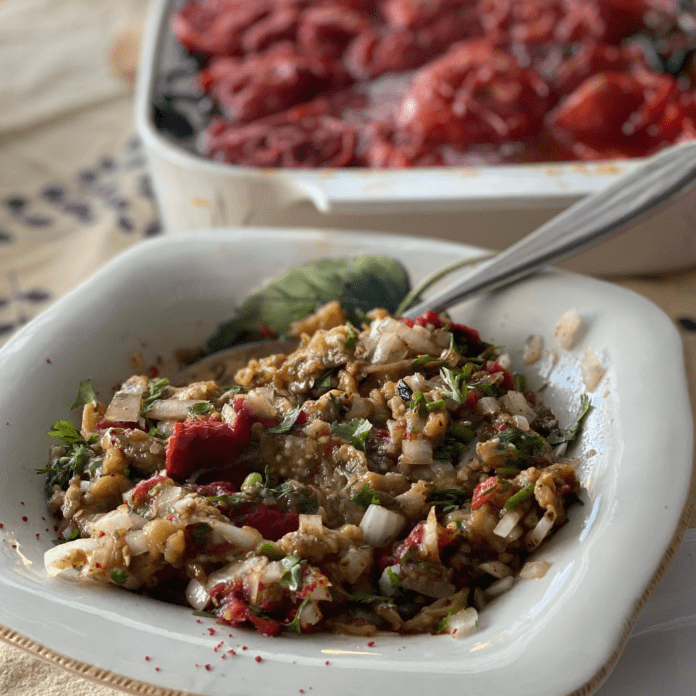
Ara Zada’s Khorovats Salad (Armenian BBQ Salad)
Born and raised in Los Angeles, Zada spent most of his younger years skateboarding and snowboarding though he always had his heart in the kitchen. He attended culinary school at Le Cordon Bleu and built a career as a Chef diving into many ethnic cultures. He has been featured on PBS No Passport Required, Discovery Channel Recipe Lost & Found and on Fox Good Day LA. He has also worked with Breville, Gelson’s and a range of others. He is a father of four, bow hunter, and a triathlete.
Zada was recently chosen as one of the 12 elite chefs competing on “Chopped: Castaways” on the Food Network on May 12, 2026. “Chopped” is a series synonymous with stress. But “Chopped: Castaways” is a day at the beach — just kidding. This new show is a spin on the classic with even more stress from the sand. Host Ted Allen welcomes 12 chefs to a remote island where they’ll have to complete physical challenges, plus cook on an open flame, all in the name of a $100,000 grand prize. The new season of “Chopped: Castaways” airs on the Food Network and is also available for streaming on HBO Max. New episodes are released every Tuesday, with the season consisting of eight episodes total.
“Growing up Armenian in America, I was constantly reminded about the Armenian Genocide. I remember sitting with my dede, grandfather, the first time he told me the story of what happened to our family. Afterward, he rarely missed an opportunity to remind me, raising a finger in front of his face, pointing to the sky and, with a stern voice, saying, ‘My grandfather, God rest his soul, was from Mardin!’”
“In the early 1900s, my great-great-grandfather Farosh Manooshian was a well-known artist in Mardin, a once-peaceful city perched on a rocky hill in what is today southeastern Turkey. But despite stories from my grandfather, the scope of what happened to make Farosh leave his hometown never really hit me until I set foot in the Genocide Memorial and Museum at Tsitsernakaberd in Yerevan. The cold, grey concrete walls were filled with images of death and torture, telling stories of soldiers who killed thousands of men, women, and children as if it were a game. As I stared at images of bodies piled up, I began to realize that the only reason I was standing in this room was because some of my family members were among those who survived.”
“Over the years, I’ve pieced together more of what happened to my great-great-grandfather. Leading up to 1915, the people of Mardin had a tradition of banding together no matter their race or religion. The governor of Mardin at the time, who had always viewed Muslims and Christians as equals, refused Ottoman orders to turn in Armenian citizens. His refusal cost him his life and the lives of his ranked officers. The next governor stuck to the Ottoman script and began carrying out orders to deport and murder all Armenians in the city. In Mardin, this time became known as ‘the year of the sword’ for the countless Armenians who were marched through the city and massacred while everyone watched.”
 Ara Zada
As my kids grow older, I will make sure that they, like me, learn the same story that my grandfather told me and that they understand their heritage. It’s up to us and every Armenian to preserve our culture and honor those who lost their lives more than a century ago. We are the survivors.”
During the show, Zada prepared khorovats, the traditional Armenian-style barbecue that holds deep cultural significance for many Armenians around the world. According to Zada, introducing Armenian cuisine to mainstream American television was one of the most meaningful parts of the experience. “Khorovats salad (Armenian BBQ salad) is a bunch of charred fruit and vegetables all chopped up and mixed together with herbs and seasoning. It’s a perfect side dish, spread or quick meal on its own. You can eat it hot or cold but typically it pairs best when you’re eating it next to your favorite BBQ meat,” he says.