Armenia’s first female khachkar master on carving and cultural preservation
The Armenian khachkar (խաչքար), which translates to “cross stone” in English, dates back to the 9th century, and is directly linked to the nation’s adoption of Christianity. Prior to khachkars, Armenians believed in vishaps, or dragon stones.. To signify the meaning of being a Christian nation, these stones are formed with three key components: the middle with the Armenian cross; the bottom, often with the Armenian infinity symbol, representing Earth, people, and humanity; and the top representing the kingdom of Heaven and God. This particular order is used to represent Christ as the union of people with God.
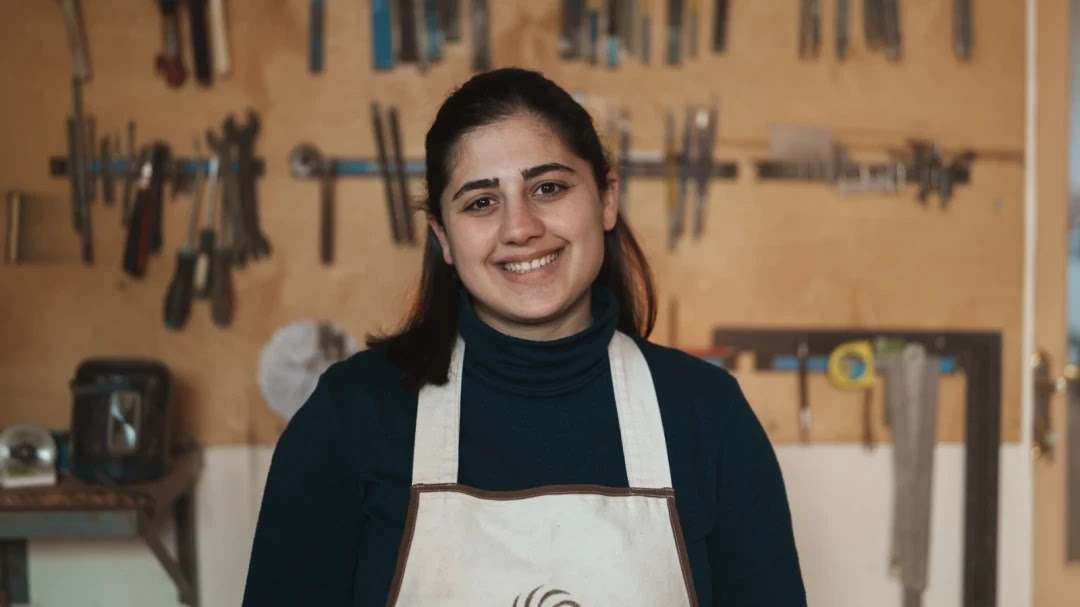
Throughout the centuries of this practice, master khachkar carvers have mostly been male. However, a Gyumri-based artist, Narine Poladian, is engraving her place in this storied history as Armenia’s first professional female khachkar carver.
Poladian first came across this art form in 2018, as a Birthright Armenia volunteer from Lebanon. With an affinity for working with her hands, she was placed at an architectural jobsite at the beginning of her time volunteering. She recounts seeing a man carve as she was walking on the street in Yerevan. This man, Hambik Hambardzumyan, would come to teach Poladian the practice of carving khachkars. What started as a hobby soon became a job: After three months, she started working at Hambardzumyan’s workshop full-time. Eight months later, she moved to Gyumri. Without the team she had learned with, she had to determine her own path forward.

“Because I couldn’t live without stone, I started working by myself,” Poladian says. Seeing demand for her work, she established her business in Gyumri.
In Poladian’s studio, each khachkar shows a different side of her work and life over the last few years. Standing along the back wall of her studio is the first khachkar she completed, which was completed during the 2020 Karabakh War. She reflects channeling her emotions around the war into her art, often resulting in her doing over a week’s work in the span of two days. But Poladian notes that, on this same stone, there are also happy memories from this time of permanently moving to Armenia and being welcomed into a new family.
Toward the bottom of this khachkar is a circle with two halves: one half with the Arevakhach (the Armenian eternity symbol) and one half with flowers. Poladian created this hybrid symbol to represent continuous life. Despite disliking flowers before coming to Armenia, she now always puts flowers on her khachkars. As many types of flowers die in the winter and grow again the following year, this half of the symbol is another representation of rebirth and resilience.
She points to another khachkar in her studio lying horizontally. This collaborative piece is a project she has been working on for three years. She started it, and when visitors come they can add their touch to it. She then goes back and adjusts the carvings.
When asked about her favorite part of her work, Poladian mentions several steps of her creative process: creating the initial designs, standing her khachkars up vertically for the first time, and giving her work to the customer. She is intentional about when and how she chooses to work.
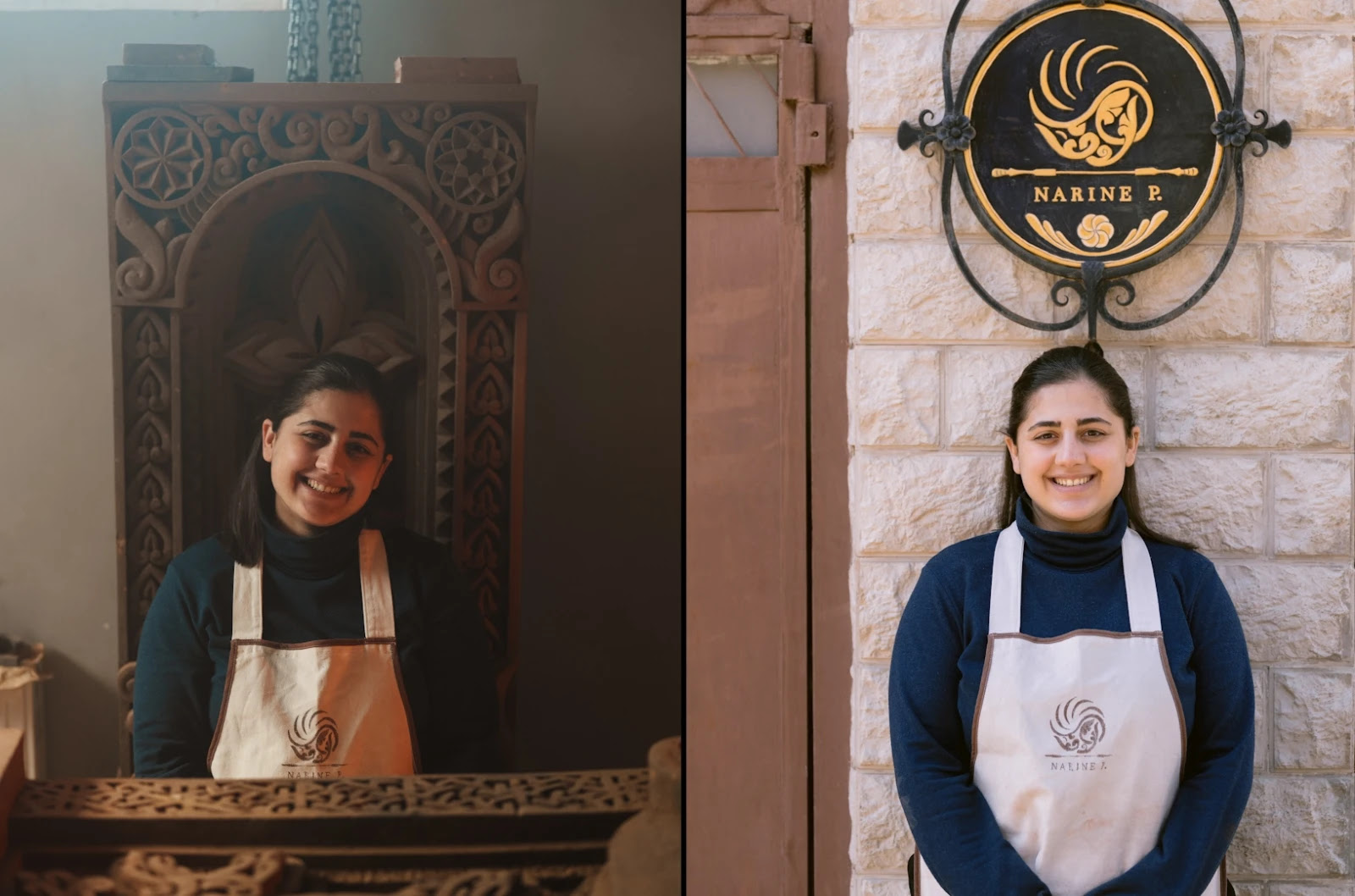
“On each khachkar you need to put feelings,” Poladian says. “For example, there are days that I come in and work for two minutes and I feel that, ‘No—today is not my day.’ Because I don’t want to put bad energy on it. So that’s why if there is an order with a very short deadline, I won’t take it.”
While Poladian works to maintain traditional techniques and patterns, she recognizes that this is not a priority for all carvers. “Unfortunately, today, many khachkar makers are focused on aesthetics and the business side of the practice,” Poladian says. With the popularization of CNC machines, which are computer-driven tools that can precisely cut materials, khachkars that used to take months to make can now be produced within an hour. These khachkars are generally cheaper than their handcrafted counterparts, often resulting in a higher demand.
Poladian has seen that machine-generated khachkars often feature fewer traditional Armenian patterns on them. She emphasizes that people can easily upload files onto CNC machines, which opens the door for other countries to claim these stones as their own. Concerned by this evolution, her call to other khachkar makers is to do their research to ensure that they are using traditional patterns and designs.
Over the centuries, khackars continue to be harmed by natural disasters or from outright destruction With this, the designs and history carried within each stone risk being lost as well.
Poladian recounts going to Dadivank, a centuries-old Armenian monastery in Nagorno-Karabakh, to remove khachkars on the last day of the 2020 war as the region was lost to Azerbaijan. Wanting to be intentional about which stones she preserved, she went with an expert to distinguish which ones had symbolic meaning and which did not. This distinction is the presence of Armenian patterns. As such, Poladian asserts that a khachkar should have more engraved than solely a cross.
Beyond the inclusion of traditional patterns, it is important to Poladian that Armenians use khachkars outside of cemeteries. In Armenia, she has observed a strong association between khachkars and gravestones. She notes with appreciation that Armenians abroad more often display them at churches and in yards as well..
With the increasing use of CNC machines and limited use of khachkars in Armenia, Poladian’s studio continues to develop new ways for people to engage with them. By offering masterclasses both in Armenia and abroad, she wants people to not only see the khachkars but also to touch and feel the emotion behind the practice.
Another part of Poladian’s efforts to preserve and develop khachkar carving is creating new ways for youth to engage with the art. For example, she has created a mailable kit for people to learn how to carve from their homes. Poladian developed this box in 2022 when she was pregnant and couldn’t be in her studio in the same way she normally was. It includes a chisel, a square stone, and a QR code with instructions for how to get started. Customers can purchase the kit by contacting Poladian directly on Instagram.
While Poladian’s studio is based in Gyumri, her work and ambitions spread beyond the physical bounds of the city. “When you work, you put your all into it,” Poladian says. “One part of me is in Miami, another part of me is in Lebanon, another in France.” Whether in Armenia or outside of it, she hopes to see more khachkars with centuries-old designs stand in places honoring many stages of life.