Azerbaijan revokes disability benefits from Second Nagorno-Karabakh War veterans
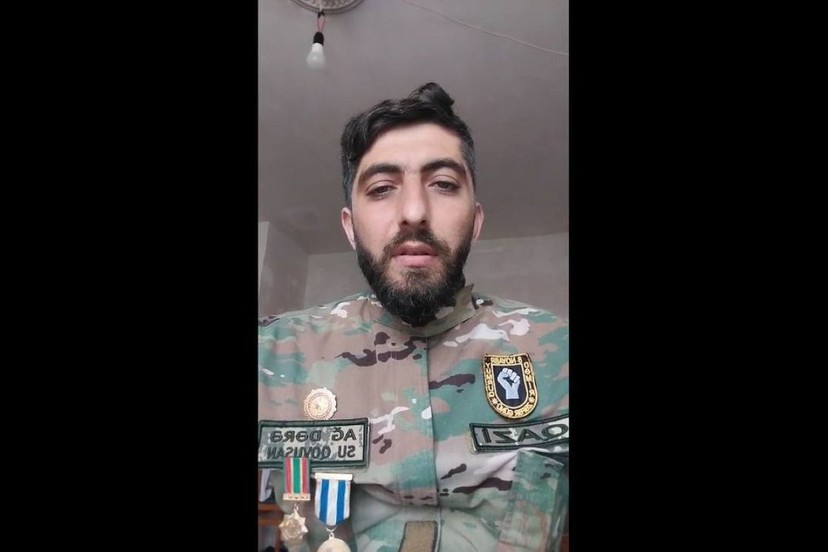
Two Azerbaijani veterans injured during the Second Nagorno-Karabakh War, Ruslan Suleymanov and Khayal Orujov, have had their disability status and corresponding benefits revoked. The serious health conditions that they incurred during their military service nonetheless remain.
The case reflects wider concerns among war-disabled veterans over disability assessments and access to state support. Authorities say the decisions are based on legally established medical criteria, while some disabled veterans say injuries that continue to impact their lives have not been recognised.
Suleymanov and Orujov claim they have faced multiple injustices over the past five years, including the cancellation of their disability status and the suspension of related benefits.
Speaking to OC Media, Suleymanov said that both he and Orujov have serious health conditions. Suleymanov suffered a traumatic brain injury and a chest fracture, adding that he had been hospitalised in Ganja, Goygol, and Baku and that his ill health — caused by war-time injuries — could be confirmed through medical commission documents. Orujov did not specify the injuries he sustained.
Both veterans said they are currently taking high doses of medication. However, according to Suleymanov, when they were summoned for an assessment by the Rehabilitation Centre for Persons with Disabilities under the Labour and Social Protection Ministry, they did not undergo detailed medical examinations.
‘They told us to look to the right and left, and asked where we had fought’, Suleymanov said.
He added that they were subsequently told that a decision would be issued within 15 days. Suleymanov claimed he knew of many other veterans that had the same experience. Some of those affected have reportedly taken their cases to court. State agencies have not issued any official statement confirming this.
Tural Gurbanov, head of a department at the State Agency for Medical and Social Expertise and Rehabilitation, told OC Media that disability status is assigned for either a fixed period or for life based on diagnoses and complications — in accordance with criteria approved in May 2022. According to Gurbanov, permanent disability status can be granted in cases involving specific medical indications and certain irreversible conditions, including amputation of the upper or lower limbs and congenital anatomical or psychiatric disorders.
Under the existing legislation, he said, disability can be assigned for one, two, or five years in cases where constant medical monitoring is required and there is potential for rehabilitation; citizens whose disability period has expired must apply for a reassessment.
Gurbanov said that Suleymanov underwent an in-person medical examination at the State Agency for Medical and Social Expertise and Rehabilitation on 14 July 2026, based on a Form 88 referral issued by a medical institution.
‘During the joint examination by medical experts from the Ministry of Health and the Agency, it was determined that the citizen’s current health condition does not provide grounds for assigning disability’, Gurbanov told OC Media.
‘For this reason, in accordance with the legislation, a decision was made that the diagnosis does not constitute grounds for establishing a disability’, he added.
The veterans claimed that when they objected to the decision at the rehabilitation center, officials referred to reconstruction and restoration work in Nagorno-Karabakh.
Suleymanov said they were also told, ‘We do not look at the documents; we make a decision by looking at your face’. Authorities denied this happened.
Suleymanov also said he has been waiting for housing in Kalbajar for more than a year despite being 11th on the official housing list. He said several groups of residents have already been relocated to the town, where he is originally from, and people below him on the list have received homes.
Suleymanov said he planned to raise the issue directly with President Ilham Aliyev during one of his visits to Kalbajar.
‘He was going to come to Kalbajar and meet with residents. I was going to tell the president about the injustices. Because they knew this, they moved people who were below me on the list ahead of me and relocated them’, he alleged.
Suleymanov’s family originally came to Baku as internally displaced persons following the First Nagorno-Karabakh War. He says they have lived in a dormitory belonging to Azerbaijan University of Architecture and Construction ever since.
Lack of official data on veterans
All war veterans in Azerbaijan receive a monthly payment of ₼80 ($50). Veterans have repeatedly said that the amount is insufficient and called for an increase.
War-disabled veterans, meanwhile, have repeatedly raised concerns that their disability status has not been properly assessed. They have held several protests outside the Labor and Social Protection Ministry over the issue.
According to war-disabled veterans, the improper assessment of their disability status has prevented them from receiving adequate social protection and benefits. The Young Veterans Public Union claim that, as a result of this situation, 40 war-disabled veterans have taken their own lives.
There are no publicly available official state statistics providing a definitive figure for the number of Azerbaijani veterans who have died by suicide since the Second Nagorno-Karabakh War, as well as other data relating to veterans.
Veterans have staged several protests in front of the Labor and Social Protection Ministry since the war’s end, demanding a fairer assessment of their disabilities.