Moscow’s latest battle with the West is its most bizarre yet
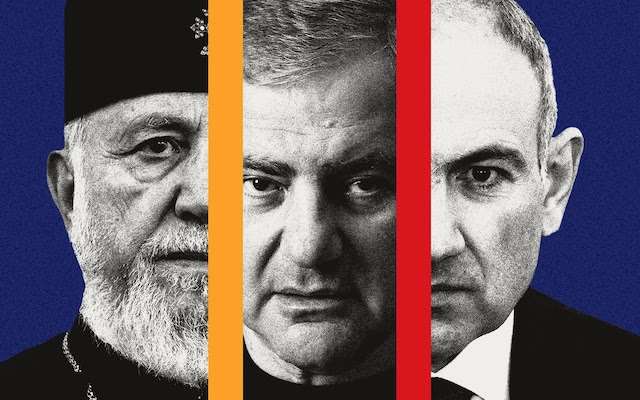
Armenia’s power struggle unfolds into allegations of psychedelic leadership, Russian influence and secret affairs
As Armenians prepare to vote in a general election next week – the latest front line in the shadow war between Russia and the West – the cost of that new prominence has become painfully clear.

Armenians will vote next week in a general election that has become a vehicle for misinformation Credit: Karen Minasyan/AFP
He returned to Armenia last year after his father’s death. Within weeks, he was under arrest.

Samvel Karapetyan, a circus-owning billionaire, has been accused of being a tool of the Kremlin
“All I meant was that I hoped to mediate the conflict,” he told The Telegraph in the grounds of his mansion in Yerevan, the Armenian capital, where he is under house arrest. “An hour later, this house was surrounded by hundreds of officers and I was arrested.”
For seven months he was held in the underground detention cells of Armenia’s national security service, the successor agency to the Soviet KGB. His arrest transformed a man better known as the proprietor of the country’s electricity grid, biggest pizza chain and leading circus into a political figure.

Karapetyan is under house arrest in his Yerevan mansion after being detained as a ‘threat to the constitutional order’ Credit: John Ranald for The Telegraph
To supporters angered by Pashinyan’s attacks on the Church, his pivot towards the West and his attempts to reconcile with Azerbaijan and Turkey, Karapetyan became a martyr.
He has rapidly eclipsed Armenia’s older pro-Russia opposition figures despite the awkward detail that, as a dual Russian and Cypriot citizen, he cannot currently serve as prime minister – a constitutional barrier he says will be removed once his newly formed Strong Armenia Party enters office.
He insists he entered politics to protect the Church from persecution.
“The government has intensified its attacks on both the Church and the Armenian national identity,” he said. “It has arrested bishops and archbishops. My concern is that he will seek to arrest the Catholicos as well.”
Church, state and deep state
Some say the real picture is less noble.
“The Church has historically aligned itself with whoever holds power,” said Artur Sakunts, a prominent Armenian human rights activist. “Under Soviet rule it was closely tied to the KGB. Before the 2018 pro-democracy revolution, it stood with the authoritarian regime. Since then it has remained close to Putin.”
Particular scrutiny has fallen on the Church’s Moscow branch, headed by Karekin’s brother, Archbishop Ezras, who in 2023 blessed commanders of the Arbat Battalion, a notorious Armenian mercenary unit fighting for Russia in Ukraine.
Ukrainian intelligence alleges that Karapetyan helped finance the battalion, a claim he denies.
Last year, Armenian authorities also claimed to have foiled a plot involving the Arbat Battalion and senior clergy aimed at overthrowing the government.
Pashinyan portrays both the church leadership and Karapetyan as a Kremlin-backed “fifth column” working against Armenian sovereignty – an accusation both men reject.
“I am simply a patriot,” Karapetyan said. “It is this government that undermines democracy at the behest of foreign forces, not me.”

Karekin II, leader of the Armenian Apostolic Church, has broken with political neutrality to demand the prime minister’s resignation Credit: Karen Minasyan/AFP
Some analysts believe the Russian threat is exaggerated.
The Kremlin discredited itself in Armenia when Russian peacekeepers stood aside during Azerbaijan’s seizure of Nagorno-Karabakh despite Moscow’s own security guarantees. Many Armenians have never forgiven what they see as a betrayal.
“Russia’s standing in Armenia has fallen sharply,” says Thomas de Waal, of Carnegie Europe, the Brussels-based think tank. “Its options in Armenia are limited. The old pro-Russian parties are discredited and Karapetyan’s movement still lacks a compelling vision.”
Polls suggest Pashinyan’s party will still emerge as the largest force. But his popularity has declined sharply since the loss of Nagorno-Karabakh, while some accuse him of growing increasingly authoritarian and portraying all dissent as pro-Russian.
“What we are seeing is less about Russia than about personalities,” said Richard Giragosian, the director of the Regional Studies Centre, an Armenian think tank. “Pashinyan is pursuing a vendetta against a church leader who is not especially popular among his own bishops, many of whom resent his political activism.”