Pashinyan highlights growing repatriation trends in meeting with Diaspora professionals
By Siranush Ghazanchyan
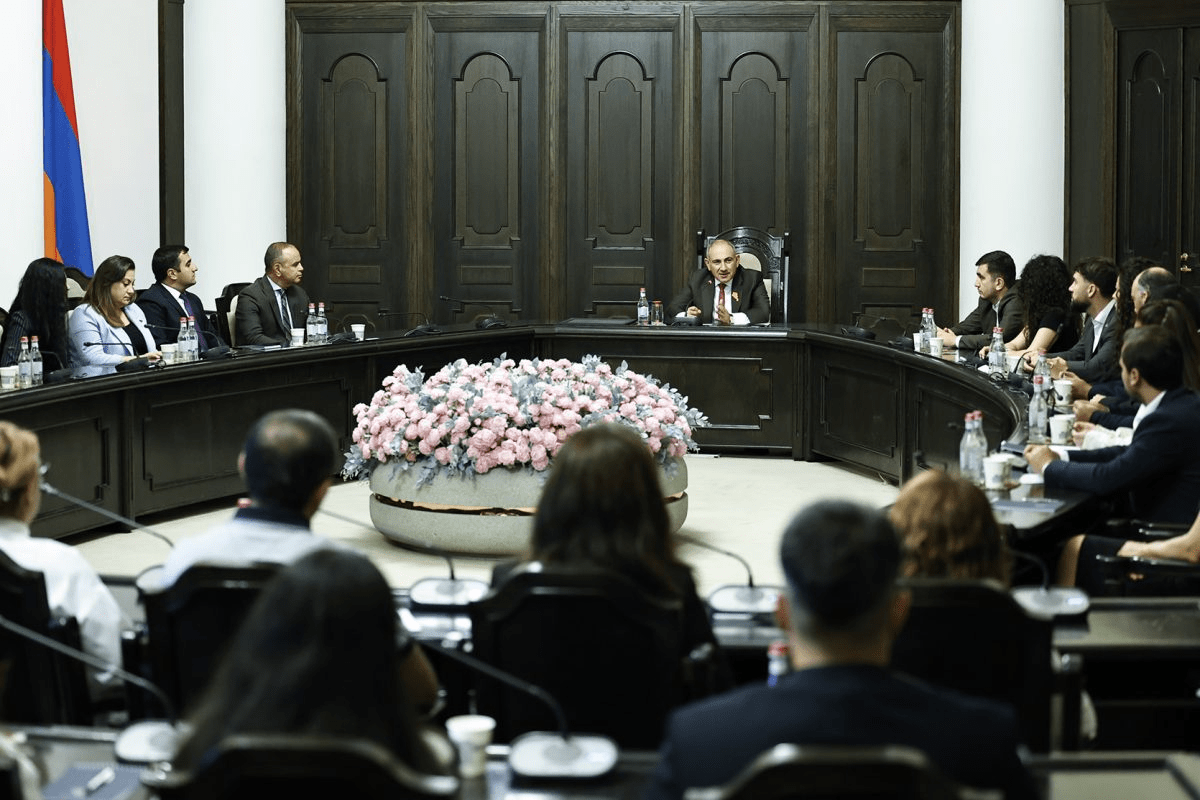
Prime Minister Nikol Pashinyan received participants of the “iGorts” program, which brings diaspora professionals into Armenia’s public administration system.
Welcoming the participants, Pashinyan said Armenia has recently been witnessing certain repatriation and immigration trends. He noted that in 2025, the number of Armenian citizens returning to the country exceeded the number leaving by more than 8,000.
According to the Prime Minister, people are returning to Armenia, purchasing property, making investments and seeking to build their lives in the country.
“Unlike 2014, and even 2019-2020, repatriation trends are becoming more confident today, including thanks to the peace agenda and established peace, because this is also a factor that we must take into account,” Pashinyan said.
He said the “iGorts” program is part of this process and expressed hope that it would become a more practical and reliable mechanism for return and integration.
Referring to his initiative to recruit graduates of the world’s top 200 universities into Armenia’s public administration system, Pashinyan said concrete appointments had already been made, with more expected in the near future. He noted that some of those appointed had first become familiar with the possibility of working in Armenia’s public administration through the “iGorts” program.
Pashinyan also spoke about the concept of “Real Armenia,” saying the government is increasingly focused on shaping Armenia’s present and future around this ideology.
“If we formulate this ideology in one sentence, it is about the meaning and significance of the Republic of Armenia as a state: ensuring the security and well-being, freedom, preservation of identity and development of its citizens within the internationally recognized territory of the Republic of Armenia,” Pashinyan said.
According to the Prime Minister, Armenia’s ideologies had traditionally been formulated by elites and imposed on society and the people. He said the “Real Armenia” ideology emerged as part of a transitional phase and was implemented rapidly.
“I am now convinced that the process of immigration will be institutionalized, because today Armenia is governed according to a logic and ideology that was not imposed on the people by elites, but imposed on the governing force by the people. Therefore, I believe this is a new situation in our history, opening limitless horizons for our state,” Pashinyan said.
He stressed the importance of moving forward by making use of these opportunities.
Pashinyan also said the ongoing repatriation trends were not accidental and expressed hope that Armenia could further develop them by reformatting relations between Armenia and the Diaspora.
“I hope that, including through reformatting Armenia-Diaspora relations, we will be able to develop this logic and truly turn Armenia into a state that develops and whose population grows primarily through repatriation and, of course, through the implementation of the demographic strategy,” he said.
He stressed the importance of human potential in implementing this strategy, describing the “iGorts” program as a mechanism for engaging with and bringing together that potential.
Acting High Commissioner for Diaspora Affairs Zareh Sinanyan thanked the Prime Minister for hosting the sixth group of the program and presented details about its implementation.
It was noted that 68-70% of participants from the previous five years have remained in Armenia, while 15% continue to work in the public administration system.
This year’s program has 45 participants from Sweden, Spain, Russia, Norway, Hungary, France, Jordan, Belarus, Brazil, Argentina, Iran and Austria.