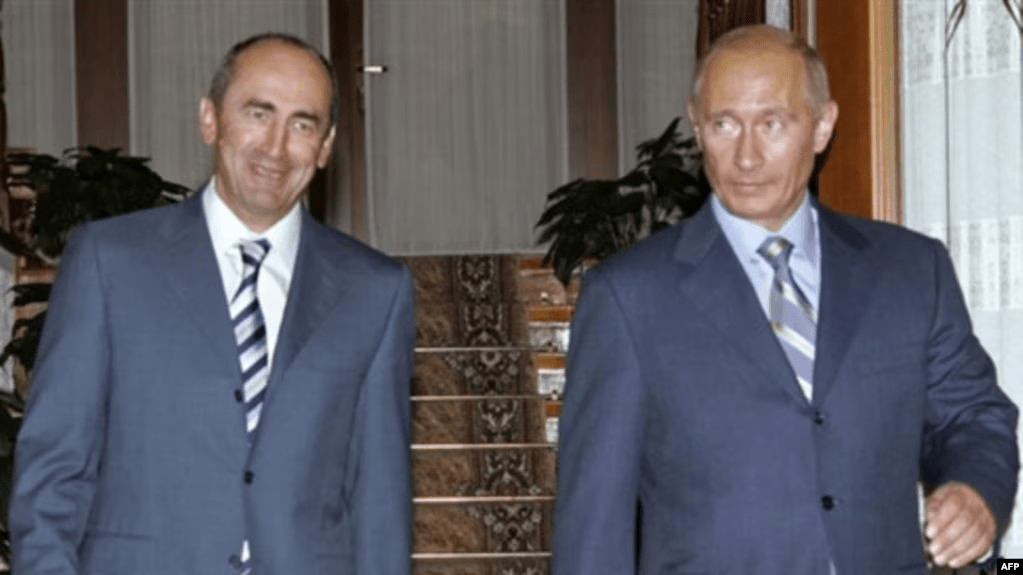
“Russia has not forgotten your personal contribution to the development of friendly and allied ties between our countries,” Putin said in a congratulatory message to Kocharian, who turned 72 on August 31, Russia’s state-run TASS news agency reported, citing a Kremlin social-media account.
“I sincerely wish you good health, spiritual strength, and resilience in the face of the challenges that you and your family are currently facing,” Putin added in comments that appeared to refer to the recent arrest of Kocharian, his son and several other people associated with him.
Kocharian, who served as Armenia’s president from 1998 to 2008 and currently heads the second largest opposition bloc represented in parliament, has been in custody since last week on charges of abuse of official powers, receiving large-scale bribes, and money laundering. He rejects the accusations as politically motivated. His eldest son, Sedrak Kocharian, has also been taken into custody on the same charges.
The Kocharians have described the case as political persecution ordered directly by Pashinian.
Yuri Ushakov, Putin’s top foreign-policy aide, said on August 28 that the Russian leader would raise the recent arrests of Armenian opposition figures when he meets with Pashinian on the sidelines of a Shanghai Cooperation Organization summit in Kyrgyzstan’s capital Bishkek on September 1.
Ushakov also indicated that Putin would again press Armenia to resolve what Moscow sees as a contradiction between its aspirations for European Union membership and its continued participation in the Russian-led Eurasian Economic Union (EEU).
“We continue to insist that Armenia cannot aspire to EU membership while simultaneously receiving enormous benefits from cooperation within the EEU framework,” TASS quoted Ushakov as saying. “This issue must be resolved somehow, and the president and the prime minister will undoubtedly discuss it.”
Putin reiterated during a July 27 phone call with Pashinian that Yerevan should hold a referendum on the issue “as soon as possible.” Pashinian has said Armenia will hold such a vote only after it formally applies for EU membership, receives a response and obtains a roadmap for the process. He said in parliament on August 24 that his government would soon launch a “process” of submitting an EU membership application, without specifying a date.
Russian Foreign Minister Sergei Lavrov criticized that position in an interview publicized on August 29, saying it “does not indicate a great deal of trust in Armenian voters or in the Armenian people.”
Moscow began pressing Yerevan to make a choice between closer European integration and continued economic ties with Russia shortly before effectively banning imports of Armenian agricultural products in late May and early June. Pashinian criticized the restrictions during his last phone call with Putin. The call came after Putin did not congratulate Pashinian on his victory in Armenia’s disputed June 7 parliamentary elections.
Tensions between the two countries have continued to rise since then, with officials on both sides trading accusations over Armenia’s European aspirations and other contentious issues.
Russian Foreign Ministry spokeswoman Maria Zakharova on August 28 condemned what she called “repressions” against pro-Russian Armenian opposition leaders, two days after Kocharian’s arrest.
Pashinian had pledged during and after the recent election campaign to have Kocharian and other former officials opposed to his government prosecuted and jailed for what he described as “illegal enrichment.” He has also accused them of being agents of foreign influence, implying their close ties with Russia.
Anna Grigorian, a Kocharian ally who heads the opposition Hayastan faction in Armenia’s parliament, told RFE/RL’s Armenian Service that the former president should be released because, in her view, his detention is illegal, rather than because Putin might raise the issue.
She said the broader crisis in Armenian-Russian relations should be resolved to prevent “an economic collapse whose consequences will be borne by Armenian citizens.”