The Armenians of Urfa and the Limits of Foreign Protection, 1919–1920
By Varouj Pogharian, Bogota, Colombia
Keghart
In the spring of 1920, the city of Urfa—known in antiquity as Edessa—became the scene of one of the most consequential episodes in the aftermath of the Armenian Genocide. For the Armenians who returned there, survival had already demanded the unimaginable. What followed demanded something different: faith in the promises of foreign protection.
A City Between Destruction and Return
By the end of the First World War, Urfa had been transformed. The Armenian Genocide of 1915 had shattered a community that had existed in the region for centuries. Deportations, massacres, starvation, and forced conversions had reduced the Armenian presence to a fraction of its former size.
The Armistice of Mudros in October 1918 briefly altered the political landscape. The Ottoman Empire had been defeated, and Allied forces began occupying strategic areas across Anatolia. British forces entered Urfa in March 1919, creating a temporary sense that the wartime chaos had ended. For Armenian survivors scattered across Syria, Lebanon, and beyond, these developments appeared to offer an opportunity. Some returned from refugee camps. Others emerged from cities such as Aleppo, where many deportation routes had ended. Their return was not driven by confidence but by necessity. Despite everything, Urfa remained home.
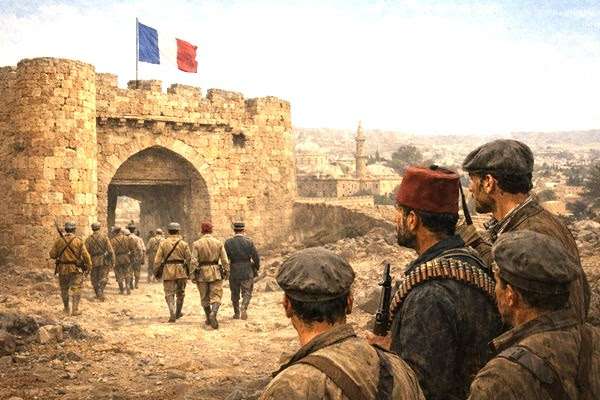
Later that year, under Anglo-French agreements that redistributed occupation responsibilities, Britain transferred control of Urfa to France. French forces entered the city in October 1919. Under French occupation, elements of Armenian communal life began to re-emerge. Schools reopened. Churches resumed limited activity. Aid organizations distributed assistance. Community leaders interacted openly with occupation authorities.
Many Armenians interpreted the French presence as more than a temporary military arrangement. France had cultivated an image as a protector of Christian communities in the Ottoman East. Armenian volunteers had served alongside French forces in formations such as the Légion d’Orient. Many believed these alliances with the Allies would eventually support an Armenian political future in Cilicia and neighboring regions.
The significance of French rule lay less in what it achieved than in what it appeared to promise. Flags, uniforms, official meetings, and military patrols suggested permanence. For a population that had survived extermination, such symbols carried enormous psychological weight.
The Armenians’ faith in the future was encouraged, nurtured, and ultimately disappointed.
The Rise of Turkish Nationalism
While Armenian communities attempted to rebuild, a rival political force was consolidating itself. The Turkish National Movement, led by Mustafa Kemal, rejected the postwar settlement imposed on the defeated Ottoman Empire. Nationalist organizations emerged throughout Anatolia and increasingly coordinated military resistance against Allied occupations.
In southeastern Anatolia, French forces soon faced sustained opposition. Fighting erupted in Marash, Antep, and Urfa. Supply lines were vulnerable, casualties mounted, and support in France for prolonged military commitments diminished. Occupation became increasingly expensive and politically difficult.
As Turkish nationalist victories accumulated, Allied governments adjusted their policies accordingly. French policymakers gradually concluded that preserving their broader strategic interests in Syria and the eastern Mediterranean mattered more than maintaining costly positions deep inside Anatolia. France increasingly sought accommodation rather than confrontation. The Armenians, who had placed their hopes in French protection, were not participants in the negotiations. In the Treaty of Ankara of October 1921, France formally recognized the new Ankara government and withdrew from contested territories in Cilicia and neighboring regions.
On 11 April 1920, a mere six months after their arrival in Urfa, French forces evacuated. The departure marked the removal of the military structure upon which Armenian life depended. When French forces withdrew from Urfa, they did more than abandon a military position. They left behind a population that had reorganized its existence around the expectation of Allied protection. It was the collapse of the belief that the victorious powers of Europe would decisively intervene on behalf of Armenian survivors.
Armenian civilians who had associated themselves with French authority suddenly found themselves exposed. Many fled. Others attempted to hide. Property was looted, arrests followed, and many families once again joined the growing ranks of refugees moving south toward Syria. Some armed groups resisted.
The precise sequence of events remains contested in some historical accounts. What is not contested is that the departure of the French eliminated the only external power willing—or able—to provide immediate protection to the Armenian population of Urfa.
The tragedy of Urfa was not that Europe was unaware of Armenian suffering. By 1920, Armenian losses were among the most documented humanitarian catastrophes of the era. The tragedy was that awareness did not translate into sustained protection.
The events in Urfa reflected a wider reality of postwar diplomacy.
In August 1920, the Treaty of Sèvres proposed the creation of a greatly enlarged Armenian state and appeared to vindicate decades of Armenian appeals for international protection. Yet the treaty only existed on paper. It lacked the military force necessary for implementation and was rejected by the Turkish National Movement.
Memory and Political Consequence
The memory of Urfa survived long after the city itself was lost to its Armenian inhabitants. It entered the collective memory of the Armenian diaspora and became part of a broader narrative of abandonment stretching from the time of the Hamidian massacres of the 1890s to the genocide of 1915, and the diplomatic failures that followed the Great War. Within that broader story, Urfa became a symbol—not only of military defeat, but of misplaced faith in external guarantees.
The campaign known as Operation Nemesis emerged from a conviction that international justice had failed. The assassinations carried out by Armenian operatives were presented by their organizers as a response to impunity and unfulfilled promises.
Lessons for Today
History never repeats itself exactly. France today is a democratic republic operating within institutions such as the European Union and NATO rather than a colonial power managing imperial possessions. The Armenia of the twenty-first century is not the Armenia of 1920.
Yet one lesson remains relevant.
Small nations often seek security through alliances with larger powers. Such alliances can be valuable, even indispensable. But they are rarely based on sentiment alone. Great powers act primarily according to their perceived interests, and those interests can change. The lesson of Urfa is therefore not that alliances are worthless. It is that no alliance should be mistaken for unconditional commitment.
For Armenians and nations situated between larger geopolitical forces, security ultimately depends upon a combination of diplomacy, partnerships, internal resilience, and realistic expectations. Foreign support may be genuine. It may even be substantial. But history suggests it should never be assumed to be permanent.
Conclusion
The fall of Urfa in April 1920 marked more than the end of a brief period of relative security for its Armenian inhabitants. It marked the collapse of a political expectation. French occupation had encouraged Armenian survivors to return, rebuild their institutions, and believe that the postwar order would provide a measure of protection. When French forces withdrew under mounting military and political pressure, that expectation collapsed with them.
States often describe their decisions in the language of necessity: strategic withdrawal, realignment, stabilization, or diplomatic accommodation. These terms explain policy, but they do not erase its human consequences. For the Armenians of Urfa, the consequence was devastating. A community that had already survived genocide discovered that international concern and international protection were not the same thing.
The significance of Urfa lies not only in what happened there, but in what it revealed about the nature of power in international affairs. By 1920, Armenian suffering was widely known. Humanitarian reports, diplomatic correspondence, missionary accounts, and press coverage had documented the destruction of Ottoman Armenian communities in extraordinary detail. Yet sympathy did not guarantee intervention, and promises did not guarantee permanence.
This does not mean that alliances are meaningless or that foreign partnerships should be rejected. On the contrary, small states often depend upon external relationships for their security and survival. The lesson is: alliances are strongest when they rest on converging interests, not merely on shared values or expressions of goodwill. When interests change, commitments can weaken, sometimes abruptly.
Urfa therefore remains relevant not because it proves that one particular country cannot be trusted, but because it illustrates a recurring pattern in international politics. Great powers may act generously, honorably, and consistently for long periods of time. Yet they remain guided primarily by strategic calculations rather than by moral obligation alone. For vulnerable nations, the wisest course is neither cynicism nor blind faith, but a clear-eyed understanding of this reality.
For Armenians, the memory of Urfa endures as a reminder that survival cannot rest entirely in the hands of others. Diplomacy, alliances, and international support are indispensable. But lasting security ultimately depends on a society’s own resilience, institutions, and capacity to adapt when external guarantees prove less certain than they once appeared.