
The Revival of Ottoman Era Railway and Türkiye’s Geo-economic Interests in the Levant
IFI Policy, American University of Beirut
Containing IMEC
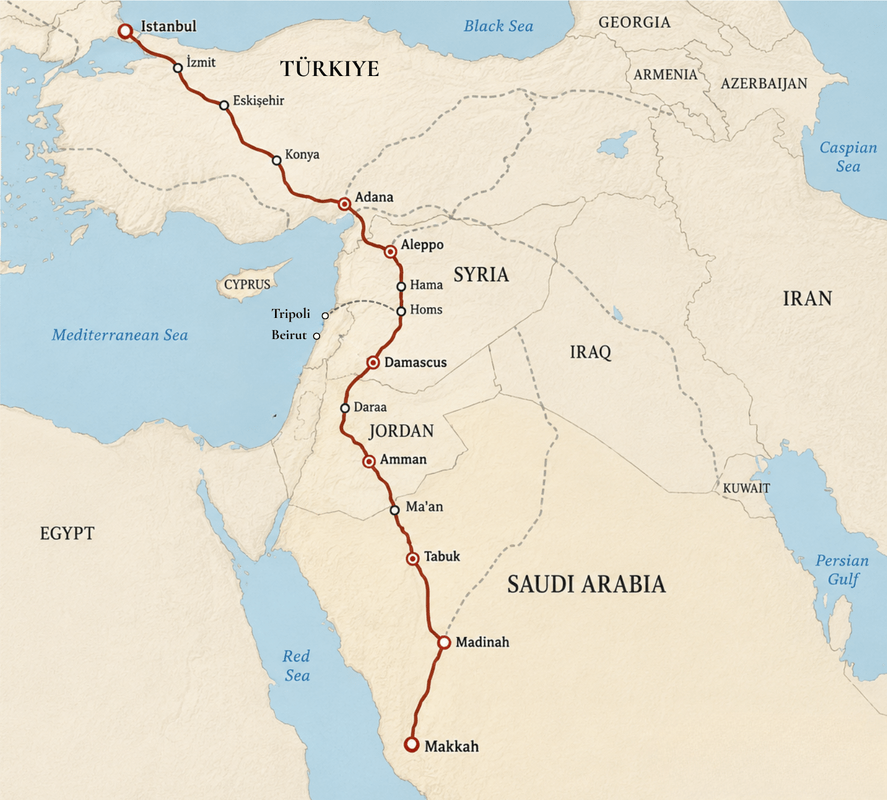
The revival of the Hejaz Railway offers an alternative geography: instead of passing through Israel and the Eastern Mediterranean, goods could move through Türkiye, Syria, Jordan, and potentially Saudi Arabia. From Ankara’s perspective, this creates a competing continental corridor that diminishes Israel’s centrality in regional logistics while increasing Turkish leverage over Gulf-European trade. Turkish expert Murat Sofuoglu argued that the conflict and the vulnerability of the Strait of Hormuz would further accelerate the implementation of the initiative. The idea also gained momentum from renewed Gulf interest in overland connectivity after the gradual stabilization of parts of Syria and the destabilization of maritime trade in the Persian Gulf and the Red Sea.
This contradicts the logic of IMEC, which was initially designed around an Indian-Gulf-Israel-Europe maritime and land route axis that bypasses Türkiye and Syria. IMEC’s strategic rationale rests on integrating the Gulf with the Mediterranean through Israel, consolidating the US position in the region, expanding the normalization wave under the Abraham Accords, and containing projects related to China’s Belt and Road Initiative in the Middle East.
However, key regional actors oppose the initiative. Türkiye clearly opposes IMEC, and President Erdogan once announced, “there is no corridor without Turkey.” Riyadh is also hesitant to join as it is not ready for a high-risk diplomatic normalization with Israel without a resolution of the Palestinian Question. This phenomenon reflects the rapprochement between Ankara and Riyadh and the convergence of interests in Syria and their growing concern about the Tel Aviv-Abu Dhabi axis. This tactical cooperation was further cemented and led to the development of a quadrilateral security framework between Türkiye, Saudi Arabia, Egypt, and Pakistan. Worry of economic isolation in the region, Israel would aim to sabotage this project and further destabilize southern Lebanon and Syria.

The Levant plays a key role in this equation. For Syria, this means reclaiming its historical role as a land bridge. Syria’s Transport Minister told SANA that before 2011, freight rail once connected Tartous port to Iraq’s Umm Qasr port via Baghdad. Damascus is actively seeking the World Bank’s help to finance infrastructure and connectivity projects aimed at rehabilitating its railways, which were once connected to its ports. Politically, the Turkish-Saudi understanding may potentially reduce Emirati leverage over Damascus.
The signing of the maritime agreement between Lebanon and Cyprus caused diplomatic friction between Beirut and Ankara. This concern was recently conveyed to Lebanese officials during high-level meetings with Turkish officials. Interestingly, Leba
Yet it also risks pulling Lebanon deeper into regional geopolitical competition, especially as rival Gulf actors seek influence over ports, infrastructure, and post-war Syrian reconstruction. This raises the broader question of whether the region is witnessing the emergence of a Saudi-Turkish alignment versus an Emirati-centered axis. While not yet a formal bloc, there are increasing signs of convergence between Turkey and Saudi Arabia around regional connectivity, economic integration, and Syria’s reintegration into the Arab order. In contrast, the UAE has focused more heavily on maritime networks, strategic ports, and IMEC-related infrastructure that reinforces Gulf-Israel-Mediterranean connectivity. This divergence could shape the future balance of power in the Levant.
Concluding Thoughts
For Lebanon, competing regional axes could deepen internal political polarization, as domestic factions align with external patrons over infrastructural questions. These would cause delays, isolate Lebanon from regional economic projects, and create tensions with Syria. For Israel, the potential emergence of a Turkish-Syrian-Jordanian-Saudi land corridor would pose a strategic challenge, eroding its position as a logistical bridge connecting Europe to the Gulf and preventing it from translating its military might into economic leverage. At its core, this is no longer an infrastructural competition but a contest over who will author the next geopolitical map of the Middle East.
This competition also places Washington in a delicate position. The US cannot easily throw its full weight behind one corridor initiative against the other, sidelining its traditional regional allies. The more likely path for US policymakers is to pursue a convergence strategy, attempting to integrate these initiatives. For this approach to succeed, it would require the US to politically invest in advancing Saudi-Israeli normalization and pressure Israel to extract concessions related to the establishment of a Palestinian state, as both remain prerequisites for any durable regional connectivity project.
Adding to this picture, the ongoing US-Iran escalation has created additional maneuvering room for Türkiye, allowing Ankara to court regional actors and advance its own geo-economic interests in shaping the political and economic map of the Levant. However, this leaves the following question to be addressed: Can Türkiye’s revival of the Hejaz Railway evolve into an inclusive connectivity project that draws in rival initiatives, or is it destined to failure and further fragment the region and create additional tensions in the Levant?
About the Author
Yeghia Tashjian is the Regional and International Affairs Cluster Coordinator at IFI.