Trump must call the Armenian genocide by its name
It’s a credibility test amid the Iran conflict
With Armenian Genocide Remembrance Day on Friday, President Trump faces a decision that transcends mere historical housekeeping.
In the shadow of the escalating conflict in Iran and instability in the Middle East, the administration’s annual statement on the Armenian genocide — traditionally a moment of rote commemoration — has been transformed into a high-stakes test of American moral leadership and strategic credibility.
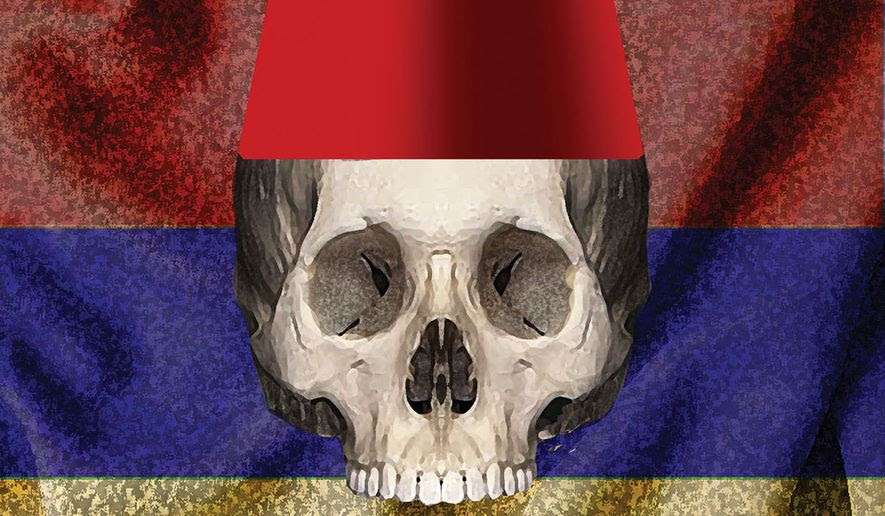
For decades, the Armenian American community has sought a simple action from the White House: Officially recognize the 1915 systematic annihilation of 1.5 million Armenians by the Ottoman Empire as a genocide.
It is an event that the Turkish government continues to deny. Although Congress moved to recognize the genocide in 2019 and a formal presidential acknowledgment was made in 2021, the current administration has spent the past year retreating into the linguistic fogginess of “great calamity” and “historical tragedy” to describe this dark chapter in world history.
This rhetorical departure is no longer just a localized disappointment for a diaspora. Rather, it has become a liability for a nation currently engaged in a volatile and unpopular war.
The administration’s conduct in the Iran war is under intense global scrutiny. With debates over the proportionality of strikes, including the attack on an Iranian school that killed more than 100 children, the United States is fighting a two-front war. One is on the physical battlefield, and the other is for the moral high ground.
Our leaders frequently invoke international norms and human rights to justify military actions, but those invocations ring hollow when those same officials refuse to apply the standards to the clear, documented facts of history.
More important, the president’s choice this Friday will determine whether his administration is serious about orchestrating a lasting and sustainable peace in the South Caucasus. The region has become a key sound bite for Mr. Trump’s foreign policy accomplishments.
A durable peace in the region cannot be built on a foundation of historical denial or strategic silence. By refusing to use the word genocide, the U.S. inadvertently signals to aggressive regional actors that historical revisionism is an acceptable tool of modern diplomacy. It emboldens those who view Armenian sovereignty as a negotiable commodity rather than a red line.
We have seen how silence about 1915 creates a vacuum that aggressive regional powers are all too happy to fill with modern-day threats against Armenian sovereignty. It is one of the reasons Azerbaijan was able to ethnically cleanse more than 120,000 Armenians from their ancestral homeland of Nagorno-Karabakh in 2023, making it the largest forced displacement of Armenians since the Armenian genocide.
If Mr. Trump wants to be the architect of a new deal for regional stability, then he must first recognize the fundamental crime that continues to haunt the region’s underpinnings.
Recognition is the currency of credibility. If the president expects the international community to trust the American narrative regarding justice and stability in a postwar Middle East, then he cannot simultaneously cave to foreign pressure regarding the crimes of the past.
Despite his “America First” rhetoric and his reputation as a disruptive dealmaker who defies the Washington establishment, Mr. Trump has become the latest leader to allow foreign capitals to effectively ghostwrite American human rights policy while contradicting the sovereignty-first doctrine he champions.
As a grandson to survivors of the Armenian genocide, I know that for my family, this isn’t about an abstract vocabulary choice. It’s about whether the United States still possesses the moral clarity and fortitude to call evil by its proper name.
Mr. Trump has a chance to close that credibility gap. By using the word genocide, he can prove that his administration’s commitment to international order is not a matter of convenience but rather a matter of conviction.
• Stephan Pechdimaldji is a communications strategist living in the San Francisco Bay Area. He is a first-generation Armenian American and the grandson of survivors of the Armenian genocide. His work has been featured in Newsweek and Foreign Policy. You can follow him on X: @spechdimaldji