Turkey and Israel will not be at war with each other: US ambassador
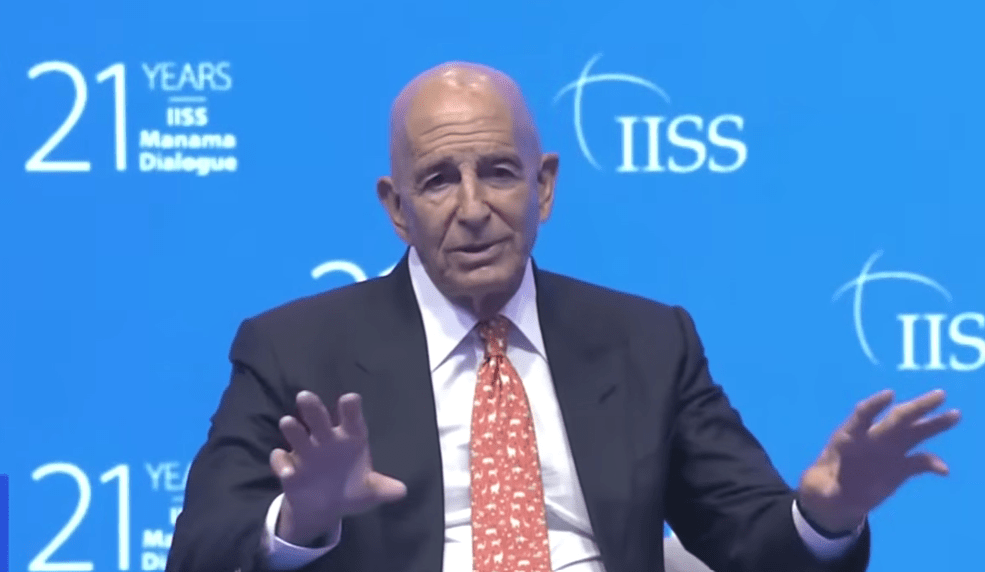
Speaking on Saturday at the International Institute for Strategic Studies Manama Dialogue, a high-profile security conference that brings ministers, generals and envoys from across the Middle East to Bahrain, Barrack tied the future of the two uneasy US allies to a broader regional alignment that also includes Syria, Azerbaijan and Armenia.
Barrack said his “bet” was that if momentum around the Gaza agreement continues, Turkey and Israel would move from confrontation toward economic cooperation.
The US ambassador said there was “no congestion [sic] between Syria and Turkey” and added, “My bet, by the way, with Turkey and Israel is if we hold together, if the momentum holds together, Jared and Steve and the great teams keep this moving in Gaza, that not too long of a time you will see a trade deal between Turkey and Israel.”
He then offered his most direct prediction:
“Turkey and Israel will not be at war with each other. In my opinion, it’s not going to happen. And you are going to get alignment from the Caspian Sea to the Mediterranean.”
Barrack’s reference to “Jared and Steve” pointed to former White House adviser Jared Kushner and real estate developer Steve Witkoff, who have been involved in talks to turn the recent Gaza ceasefire into a longer-term political framework under President Donald Trump’s second administration.
Barrack’s comments come against the backdrop of the October 9 Gaza peace agreement announced by Trump, which set out a phased Israeli withdrawal from Gaza along with a prisoner exchange deal between Israel and Hamas and a sharp increase in humanitarian aid for the enclave.
He suggested that if that agreement holds and expands, it could unlock a wider regional realignment that would include Turkey, Israel and Syria, as well as newly improving ties between Azerbaijan and Armenia.
“Look what is happening above,” he said in the same talk, pointing to Azerbaijan and Armenia as an example of former enemies who are now moving into a US-backed regional architecture that stretches from the South Caucasus to the eastern Mediterranean.
The envoy’s prediction of a future trade deal contrasted with the current state of relations between Ankara and Tel Aviv.
Turkey halted all direct trade with Israel on May 2, 2024, when the Turkish Trade Ministry announced that all exports and imports “covering all products” had stopped, in response to Israel’s military campaign in Gaza and domestic pressure over images of mass civilian casualties.
President Recep Tayyip Erdoğan has repeatedly described Israel’s actions in Gaza as genocide, joined the case against Israel at the International Court of Justice and cast Turkey as one of the few states willing to use economic tools against Israel.
Turkish officials say the trade embargo remains in force and stress that it will only end after a permanent ceasefire in Gaza and an uninterrupted flow of humanitarian aid.
At the same time, shipping and customs data reviewed by independent outlets show that hundreds of vessels have continued to sail between Turkish ports and Israel since the embargo was announced, often through intermediaries, sparking criticism from activists who accuse Ankara of hypocrisy.
Israeli officials, for their part, now describe Turkey under Erdoğan as a hostile actor because of its rhetoric, trade measures and legal moves at the ICJ.
Deconfliction in Syria and the ‘March 10’ agreement
Barrack’s claim that there is “no ‘congestion’ between Syria and Turkey” referred to a separate track where Washington has tried to manage overlapping Turkish, Syrian and Kurdish interests after the fall of the Bashar al-Assad regime.
On March 10 Syria’s new president, Ahmed al-Sharaa, and the Kurdish-led Syrian Democratic Forces (SDF) signed a US-brokered agreement that laid out a plan to integrate the SDF units into the Syrian national army. Implementation stalled for months but has picked up pace after recent meetings in Damascus and Hasakah, with US mediation.
Turkey, which views the SDF as an extension of the outlawed Kurdistan Workers’ Party (PKK) and has long carried out cross-border operations in Syria, has opened its own channels to the new Syrian government and is negotiating a defense pact that would give its forces access to Syrian bases and airspace.
In parallel, Turkish and Israeli officials have quietly launched technical talks in Azerbaijan to prevent accidental clashes in Syrian airspace, where both militaries now operate. The mechanism is meant to avoid incidents, not to normalize diplomatic relations, but it underscores that both sides want to keep their rivalry below the threshold of open war.
Barrack, a longtime Trump confidant and real estate investor, now serves as US ambassador to Turkey and special envoy for Syria. He has used that dual role to promote what he describes as a Trump doctrine that reduces direct US military involvement and pushes regional powers to “take ownership” of their own security while the United States acts as broker and guarantor.
In his Bahrain appearance, Barrack credited Turkey with playing a central part in securing the Gaza agreement and in talks to restructure Syria’s security architecture, while also insisting that Israel will remain a key US partner in the same system.