Yerevan has become a haven for exiled Russians defying Putin
Russians fleeing their president and his war have found a home in the Armenian capital
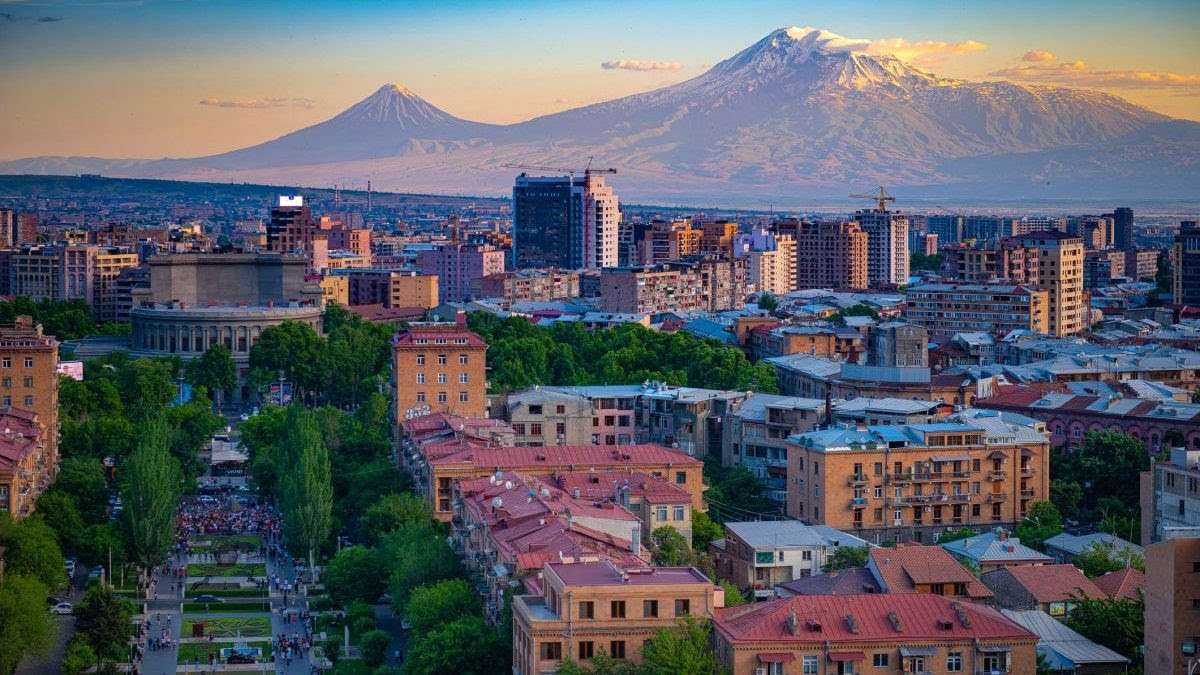
Mount Ararat is a symbol of Yerevan and on clear days can be seen beyond the rooftops (Photo: Emad Aljumah/Getty)
Gergana Krasteva, inews.co.uk
YEREVAN, ARMENIA – Egor* was not going to wait for the Russian state to come for him. However, it wasn’t until his plane touched down at Zvartnots International Airport in Yerevan, 24 hours after he resigned from his surveillance job with the St Petersburg police force, that he felt some level of safety.
The 31-year-old had already been turned away at the border with Georgia, and Armenia was his last shot at escaping after taking part in anti-Kremlin protests.
“I was afraid because [police] could quickly find me and I would have problems. It made me feel like I was a coward,” he tells The i Paper.
Four years have now passed since his grandmother – who vividly recalled the horrors of the Second World War – urged him to flee from another conflict. “Leave, there is no need to fight,” he remembered her telling him in April 2022, weeks after Russia launched its full-scale invasion of Ukraine.
But escaping Russia was not the hardest part. Accepting that he will probably never return home – and that he would have to build a new life elsewhere – proved far more daunting.
“I took all the money I had… and left,” he said. “I did not think about what will happen in Russia, but about what will happen in Ukraine.”
Egor found work as a chef in a cafe alongside fellow political exiles from Russia, Belarus and Ukraine. “Today, this cafe is my family,” the now-photographer says. “I found love there and we live together, the chef and the owner are my friends.”
Yerevan, one of the world’s oldest continuously inhabited cities, has in recent years become a sanctuary for Russians fleeing war, mobilisation and political persecution. Over 60,000 Russians have arrived in Armenia since 2022, according to government data, which has helped to transform the city.
 Russians fleeing Putin’s war have flocked to the streets of Yerevan, Armenia’s capital (Photo: Giovanni Mereghetti/UCG/Universal Images Group via Getty Images)
Walking around the centre, it is a city transformed, but also one constantly wary of the Russian bear close by, as Vladimir Putin’s war with Ukraine drags on.
As the first column of Russian tanks entered Ukrainian territory in 2022, Anya* purchased a one-way ticket to Yerevan, carrying a backpack and $100 in cash.
“There was no time to hesitate. I thought, ‘F*** it, I am leaving,’” she tells The i Paper.
Born to a Russian Armenian family in Moscow, Anya grew up feeling like an outsider in a society she describes as deeply Slavic-centric. At school, the now 36-year-old was taunted for her jet-black hair and darker complexion, and long before the war, she had found her place on the political margins.
She was part of Russia’s anti-fascist scene and, throughout her 20s, attended anti-government demonstrations. She became close to the inner circle of Alexei Navalny, the jailed Russian opposition leader and Putin critic who was found dead in 2024, allegedly poisoned with an exotic frog toxin from South America.
 As the first column of tanks entered Ukrainian territory, Anya* bought a one-way ticket to Yerevan (Photo: Gergana Krasteva)
Exile has brought more than safety. Living in Yerevan, she felt free enough to come to terms with her LGBTQ sexuality.
It is another reason why returning to Russia is unthinkable, and Yerevan is now her home.
Many of those fleeing Russians who settled in Yerevan had first escaped to Georgia, crossing the only land border with Russia that remained accessible after the start of the war with Ukraine.
But as Georgia’s ruling party steered the country away from its pro-Western path, the political crackdown deepened and some Russian dissidents felt, once again, that it wasn’t safe and that it was time to move on – further away from Putin’s reach.
Yaroslav*, who worked in a bookshop in Moscow, was one of them.
His days in Yerevan are now deliberately calm – working from home for a bookshop, sketching in the evenings and watching his favourite show, The Sopranos.
But scenes of beatings and intimidation drag him back to his own experiences – being arrested during anti-government demonstrations in Tbilisi, thrown into a cell for 10 days and threatened with rape.
“Watching The Sopranos helped me understand the psychology of Georgian police and the people involved in the structure of violence,” the 25-year-old tells The i Paper, over a plate of falafel at a Russian-owned cafe.
It is only a year later that he is beginning to feel safe. Before he fled, Georgian authorities had released him and given him an ultimatum – leave or face extradition to Moscow. But returning to Russia was never an option, as he had already been arrested there for taking part in anti-war demonstrations.
 Protesters shoot fireworks toward police during nationwide protests against a government decision to shelve EU membership talks in Tbilisi, Georgia, in December 2024 (Photo: Giorgi Arjevanidze/AFP via Getty Images)
Yaroslav adds: “For the first time in a long while, I didn’t feel threatened by the police or by state.”
While Yaroslav has found safety, his thoughts remain fixed on his mother and sister, who continue to live on the outskirts of Moscow, next to a railway line used to transport military equipment.
Polina*, 23, also has parents still living in Moscow, which is now experiencing a surge in Ukrainian drone strikes aimed at pressuring Putin and the Kremlin to end the war.
Since leaving Russia in 2023, first to Sri Lanka and then to Armenia, the illustrator believes she has made enemies back home with her art – so the idea of returning to reunite with her family makes her feel uneasy.
“For me, it became impossible to stay in Russia,” she says. “Propaganda was everywhere. I couldn’t tolerate it. It was unfair to stay silent, but it was impossible to speak openly, too.”
Polina now works with other Russian artists in Yerevan on anti-war projects, but says that none of it can be published in Russia. Still, she says, “Here, at least, I know I am not participating in the war machine”.
 ‘It became impossible to stay in Russia,’ says illustrator Polina* (Photo: Gergana Krasteva)
The artist explains that she is looking after the dog while the family arranges travel documents to bring it to their new home. It is another example of the tight-knit community the exiled Russians have created in the country.
In many ways, Egor’s life has gone through the biggest change, having worked within the Russian state as a police officer before fleeing the country.
While he does not regret his decision to leave, he misses the opportunity of not being a guest in another country. “I have a homeland. The Murmansk region… In Russia, people talk about the motherland as a fairy tale,” he says.
But he also describes himself as a realist and doesn’t see “any prospects” for change in Russia, even when Putin eventually dies. As such, he is focused on creating a new life for himself.
“My planning horizon is half a year to a year,” he says. “Now, I’m in Armenia and I would like to become a citizen of the country.