When Church Autonomy Becomes a Criminal Case: Armenia’s Unprecedented Confrontation with the Apostolic Church
By Lilia Shushanyan
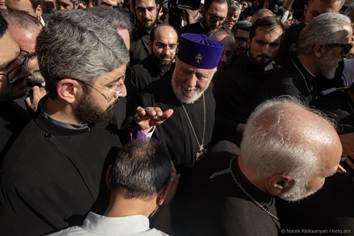
For more than a year, the Armenian Apostolic Church has faced sustained and mounting pressure from the Government of Armenia and Prime Minister Nikol Pashinyan. On 7 August 2026, these developments reached an unprecedented point in the history of independent Armenia: His Holiness Karekin II, Supreme Patriarch and Catholicos of All Armenians, appeared before a court in connection with a criminal case widely perceived by critics, both in Armenia and internationally, as politically motivated.
The developments have also prompted international concern. On 7 August, the World Council of Churches (WCC) expressed “deep concern” over the situation surrounding the Armenian Apostolic Church, specifically warning against “undue interference in the internal affairs of the Church.” The WCC reaffirmed its solidarity with the Armenian Church and its faithful, demonstrating that concerns over the current confrontation have extended beyond Armenia’s domestic political debate.
The Criminal Case
On 7 August, a preliminary hearing was held in the criminal case against Catholicos Karekin II and six bishops. The term “criminal case” would normally suggest allegations of serious criminal conduct. Yet the case against the Catholicos of All Armenians arises from his January 2026 dismissal of Bishop Gevorg Saroyan as Primate of the Masyatsotn Diocese — an internal ecclesiastical decision taken under the Church’s governance rules.
In January 2026, Bishop Saroyan challenged his dismissal before a secular court, effectively bringing an internal canonical dispute before the judiciary. Notably, Saroyan had previously signed an initiative calling for the removal of Catholicos Karekin II alongside Prime Minister Nikol Pashinyan, who signed the initiative explicitly in his official capacity as Prime Minister.
The case inevitably raises concerns regarding judicial independence and the broader political environment in which these proceedings are taking place. Such concerns are particularly sensitive in light of Prime Minister Pashinyan’s widely cited 2019 remark: “Is there a judge in Armenia today who wouldn’t do what the Prime Minister says?”
The Regional Court of First Instance subsequently ordered that Saroyan remain in office pending resolution of the case and prohibited the Church from interfering with the exercise of his authority, including his management of the diocese’s financial accounts. Karekin II and the Supreme Spiritual Council subsequently decided to defrock Saroyan. According to the Prosecutor’s Office, this decision deliberately circumvented and violated the court order.
What about the 7 August hearing?
Judge Hakob Manukyan, who had been assigned to the case, recused himself. Irrespective of the formal grounds for his recusal, it is understandable that any Armenian judge may find it deeply difficult to become involved in proceedings of such an unprecedented and highly sensitive nature. The question now is how many judges may ultimately be called upon to consider the case before it proceeds. Given widespread concerns over governmental pressure on the judiciary, there is also a strong public perception that the next judge assigned to the case may be carefully “chosen”.
From Personal Campaign to Government Policy
The Armenian Apostolic Church does not provide for the removal of the Catholicos through a political or other external initiative.
When Prime Minister Pashinyan initially became personally involved in the campaign against the Catholicos, he presented his actions as those of an individual member of the Church rather than as an exercise of governmental authority. This distinction has since become increasingly difficult to maintain.
Prime Minister Pashinyan subsequently signed an initiative concerning the removal of the Catholicos explicitly in his official capacity as Prime Minister, while proposals concerning the removal of the Catholicos and changes to the Church’s governance were later incorporated into his party’s official electoral platform.
These developments raise broader concerns regarding the boundary between state authority and the constitutional autonomy of a religious institution, particularly when secular state institutions are being drawn into disputes concerning the internal governance and hierarchy of the Armenian Apostolic Church.
A Broader Pattern of Pressure
The criminal case against the Catholicos does not stand in isolation. Over the past year, a series of measures affecting the Armenian Apostolic Church and its institutional position have been introduced or pursued.
These have included the withdrawal of state-provided security for the Catholicos; changes affecting military and prison chaplaincy arrangements; and the removal of the separate “History of the Armenian Church” subject from the school curriculum, despite its teaching remaining provided for by law.
The political context has added further significance to these developments. Following Armenia’s highly controversial parliamentary elections of 7 June 2026, another unprecedented development occurred at the opening of the newly elected National Assembly. For the first time since Armenia regained independence in 1991, the Catholicos of All Armenians was not invited to address the opening sitting of Parliament, despite the National Assembly’s Rules of Procedure expressly providing for such an address.
The two opposition parliamentary groups — Strong Armenia and the Armenia Alliance — condemned the decision as unconstitutional and unlawful and, following the sitting, travelled to the Mother See of Holy Etchmiadzin to receive the Catholicos’s blessing.
An Unprecedented Situation in Independent Armenia
Taken together, these developments represent an unprecedented situation in the history of the Republic of Armenia. Never before since independence has the head of the Armenian Apostolic Church faced criminal proceedings of this nature amid an open campaign by the country’s executive leadership concerning the leadership and internal governance of the Church.
The historical symbolism is particularly troubling for Armenians. Throughout different periods, the Armenian Apostolic Church has faced severe pressure under foreign and authoritarian rule. One of the darkest episodes occurred during the Stalinist repression of the Church: in 1938, Catholicos Khoren I died in circumstances widely attributed to Soviet security authorities amid the broader campaign against Armenian clergy and religious institutions.
Against this historical background, the appearance of the Catholicos of All Armenians before a secular court over an internal ecclesiastical decision carries significance far beyond the individual criminal case.
Legal and Human Rights Concerns
The current developments raise serious questions regarding Armenia’s obligations under its own constitutional and legislative framework, as well as European human rights standards.
The Constitution of the Republic of Armenia
The Constitution expressly recognizes the exclusive mission of the Armenian Apostolic Holy Church in the spiritual life of the Armenian people, the development of their national culture and the preservation of their national identity, while simultaneously establishing the separation of religious organizations from the State.
The Law on Relations between the Republic of Armenia and the Armenian Apostolic Holy Church
Article 2 recognizes the Armenian Apostolic Holy Church as the national Church and expressly recognises “the self-governance of the Armenian Apostolic Holy Church within the limits of its hierarchy.”
The Law on Freedom of Conscience and Religious Organizations
Article 17 establishes that the Church is separate from the State and provides that the State “shall not interfere in the lawful activities and internal affairs of the Church and religious organizations.”
The provision further prohibits the activities of any state body, or persons acting on its instructions, within the structures of churches and religious organizations.
The European Convention on Human Rights and ECtHR Case Law
The developments also raise concerns under Articles 9 and 11 of the European Convention on Human Rights (ECHR), protecting freedom of religion and association. The ECtHR has consistently recognized the autonomy of religious communities as fundamental to democratic pluralism, including their right to organize their leadership and internal affairs free from arbitrary state interference.
Conclusion
The appearance of the Catholicos of All Armenians before a court in these circumstances goes far beyond an individual criminal case. Taken together with direct political initiatives concerning the leadership of the Church, measures affecting its institutional position, and the involvement of secular institutions in questions of internal ecclesiastical governance, it raises fundamental concerns regarding religious freedom, Church autonomy, separation of Church and State, judicial independence and the resilience of democratic institutions in Armenia.